What is Fronting in Speech Therapy, and Example of Fronting
March 14, 2023
How to Teach B Sound: Articulation Activities, and Word Lists for Effective Speech Therapy
March 15, 2023
How to Teach P Sound: Articulation Activities, and Word Lists for Effective Speech Therapy
To teach the P sound, have the child press both lips together, build up a little air, then pop the lips open in a quick puff — with NO voice. It’s one of the easiest and most visual sounds: hold a hand (or a small piece of tissue) in front of the mouth and the “p” puff will move it. The trick that separates P from B: P is quiet (just air), B uses the voice. Have the child touch their throat — it stays still on “p” and buzzes on “b.” Practice in order: the sound alone, then syllables (pa, pe, po), then words (pig, pen, top), then phrases and sentences. The /p/ sound is one of the earliest to develop, usually by age 2 to 3. If your child says “b” instead (“big” for “pig”), the fix is turning the voice OFF and letting the puff of air do the work.
The “p” sound is a voiceless bilabial plosive, which means that it is produced by briefly stopping the airflow from the lungs using both lips (bilabial) and then releasing it in a sudden burst (plosive). Unlike the “b” sound, the vocal cords do not vibrate during the production of the “p” sound. To produce the “p” sound, you need to bring your lips together and then release them while simultaneously stopping the airflow from your lungs. This creates a sudden burst of sound that is characterized by a brief, sharp “pop” or “explosion” of air. You can try producing this sound by saying the word “pat” or “poke” and paying attention to the way your lips and breath work together to create the sound. In phonetics, this sound is represented by the symbol /p/.
Initial P Words (words that start with P)
1-syllable: pack, page, paint, pan, park, part, pass, paste, pat, path, paw, pay, pea, peace, peach, peak, pear, peas, peck, peek, peel, peg, pen, pet, pick, pie, pig, pill, pin, pink, pipe, pit, poke, pole, pond, pool, pop, pot, pour, pouch, pound, pup, purse, push, put
2-syllable: panda, paper, parent, parking, parrot, party, passing, patch, pattern, peaches, peanut, pebble, pedal, pencil, penny, people, pepper, petal, pickle, picnic, picture, pigeon, pillow, pilot, pizza, pocket, pointy, poison, pony, popcorn, poppy, potty, powder, power, pretzel (blend), puddle, pumpkin, puppet, puppy, purple, pushup, puzzle
Medial P Words (P sound in the middle)
2-syllable: apple, apron, campus, carpet, chapter, copy, cupcake, diaper, happy, helper, hippo, keeper, napkin, open, paper, People (cap—fix), pepper, puppet, puppy, rapid, repeat, ripe, super, tiptoe, topic, zipper
3-syllable: alphabet, caterpillar, envelope, hospital, newspaper, opera, telephone, vampire
Final P Words (words that end with P)
1-syllable: cap, chip, chop, clap, cup, deep, dip, drop, flap, grape, gulp, harp, help, hip, hoop, hop, jump, keep, lamp, leap, lip, map, mop, nap, pop, pump, ramp, rip, rope, sheep, ship, shop, sip, skip, sleep, slip, snap, soap, soup, step, stop, tap, tip, top, trap, trip, up, wipe, wrap
2-syllable: catnip, ketchup, laptop, rooftop, tulip, turni
Here are few tips you can follow to teach the “P” sound:
Popcorn: Introduce the “P” sound by making popcorn with your child. As you pop the kernels, emphasize the “P” sound and ask your child to repeat after you. This can make learning the sound more fun and memorable for them.
Pretend Play: Encourage your child to make the “P” sound while engaging in pretend play. For example, they can pretend to be a pirate saying “Arrr, matey! Pass the popcorn, please!” or a superhero saying “Pow! Punch that pesky villain!”
Practice Blowing: Help your child get used to the sensation of stopping and releasing air with their lips by having them practice blowing bubbles or blowing up balloons while keeping their lips together.
Tongue Placement: Show your child how to place their tongue behind their teeth and keep their lips closed while making the “P” sound. You can make it more fun by having them imitate animal sounds, such as a pig snorting or a snake hissing, while using the “P” sound.
Practice in Isolation: Have your child practice making the “P” sound on its own, holding it for a few seconds to feel the vibration in their lips. You can also use a mirror to help them see the correct mouth and lip movements.
Add Syllables: Once your child has mastered the “P” sound in isolation, have them practice using it in different syllables, such as “po,” “pi,” and “pa.” You can make it more fun by having them say silly words like “puppy,” “pepperoni,” and “pickle.”
Practice in Words: After your child has mastered the “P” sound in syllables, have them practice using it in words like “pizza,” “pen,” and “pillow.” You can also have them come up with their own words with the “P” sound. Use our free p sound words memory games to teach P Initial Words, P Medial Words & P Final Words.
Practice in Phrases: Have your child practice using the “P” sound in different phrases, such as “pretty pink pig,” “playful puppy,” and “popcorn party.” You can make it more engaging by having them say the phrases in a rhythmic pattern.
Practice in Sentences: Finally, have your child practice using the “P” sound in different sentences, such as “Peter Piper picked a peck of pickled peppers,” “I love popcorn,” and “My puppy’s name is Pepper.” You can also have them practice saying the sentences with different emotions to make it more expressive.
Practice Everywhere: Encourage your child to practice using the “P” sound in different contexts, such as during playtime, mealtime, or while reading books. You can also make it more fun by having them use the “P” sound in different accents or dialects.
More P Sound Practice
Everything you need to practice the /p/ sound — from single words to full sentences.
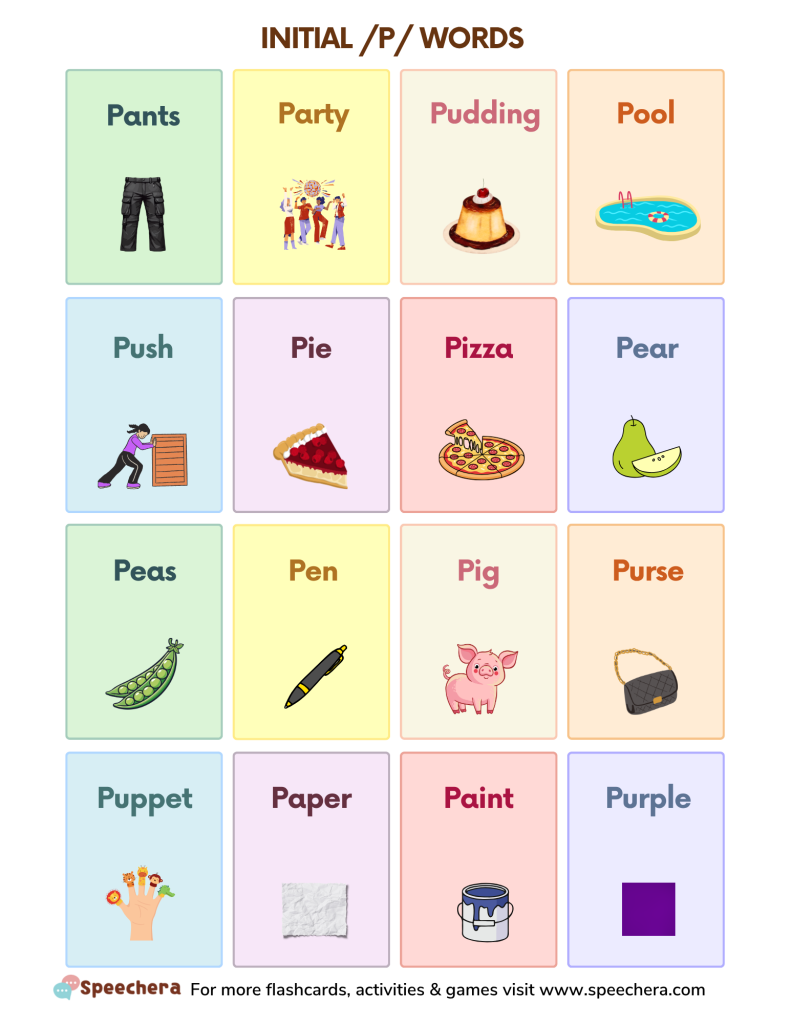
Download Free P Sound Articulation Flashcards Worksheet
Free P interactive audio flashcards featuring words with the “P” sound words can be a useful tool for improving pronunciation and vocabulary.
P Sound FAQs
At what age should a child say the P sound?
The /p/ sound is one of the very first consonants to develop, usually by age 2 to 3. If a child isn’t using it by age 3, it’s worth mentioning to a speech-language pathologist.
Why does my child say B instead of P?
B and P use the exact same lip movement — the only difference is that P is voiceless (just a puff of air) and B is voiced. Saying “big” for “pig” is called voicing. Have the child hold a hand in front of the mouth: P makes a puff, B barely does.
What’s the difference between the P and B sounds?
Both are made by popping the lips apart. P is voiceless (quiet, with a strong puff of air) and B is voiced (the throat buzzes). Touching the throat or holding a tissue in front of the mouth makes the difference easy to feel and see.
What are good first P words to practice?
Start with simple, fun words like “pig,” “pen,” “pie,” and “pop,” where the P begins the word and the lips are easy to watch. Popping bubbles or making popcorn sounds is a playful way to practice.