G Words in Speech Therapy
November 19, 2025
Ch Words in Speech Therapy
November 19, 2025Introduction to F Words in Speech Therapy
Hello, parents! If your child is struggling on the F sound, this guide is here to help. The F sound—a voiceless labiodental fricative made by lightly pressing the bottom lip against the upper teeth and blowing air—is typically mastered by age 4, but some kids may replace it with “P” (e.g., “pish” for “fish”) or struggle with its airflow. This article provides lists of F initial, medial, and final words, plus practical tips to make practice fun and effective at home, empowering you to support your child’s speech with flair.
Because F is so visual, a mirror is one of your best tools — your child can watch the top teeth touch the bottom lip and see exactly what to do. Some children like a fun name for it: the “angry cat” sound (a hissy “ffff”) or the “leaky tire” sound. The most common F difficulty is saying “P” instead (“pan” for “fan,” “pish” for “fish”), which happens when the lips pop together instead of the teeth resting on the lip — so the cue “bite your lip and blow” usually does the trick.
On this page you’ll find a complete, organized list of F words — grouped by position and syllable count so you can start simple and build up — along with free printable worksheets, games, and a plain-language explanation of the sounds most often confused with F. New to teaching this sound? Start with our full guide on how to teach the F sound, then come back here for the word lists and practice resources.
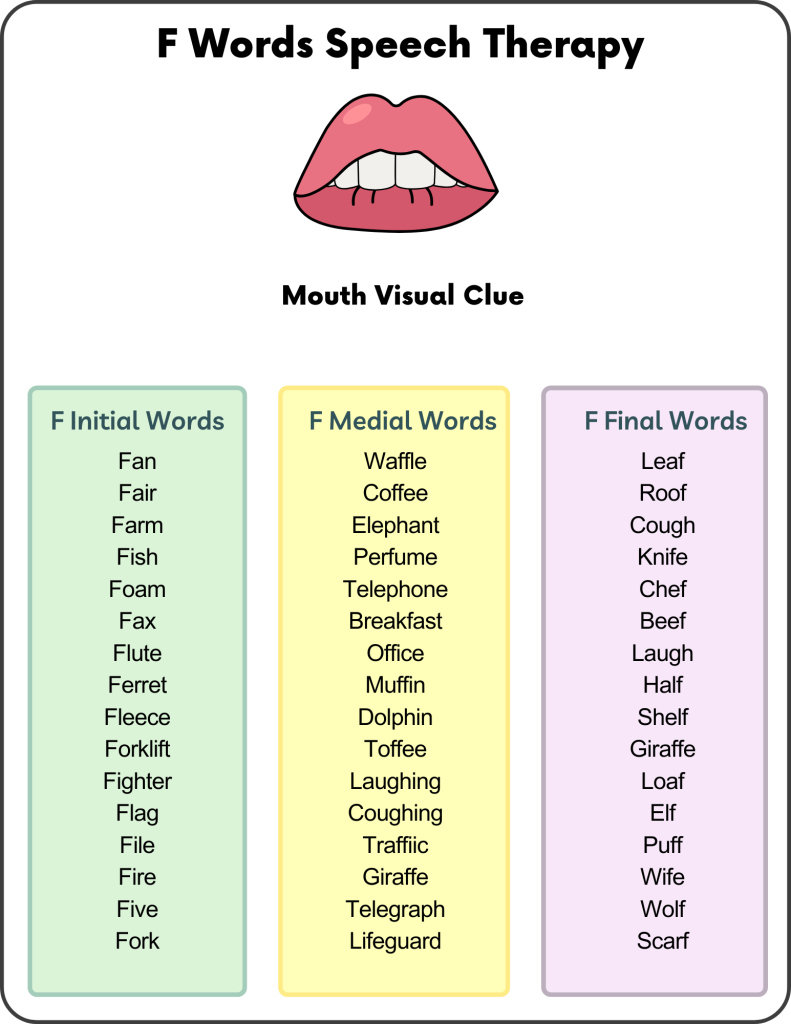
F Words Speech Therapy Printable PDF Worksheet
Understanding F Word Positions
- Initial F Words: These begin with F, like “fish” or “fan,” where the sound starts with a clear, airy hiss.
- Medial F Words: These have F in the middle, such as “coffee” or “waffle,” blending F with other sounds.
- Final F Words: These end with F, like “leaf” or “wolf,” requiring a steady, voiceless finish.
F’s voiceless nature (no vocal cord vibration) sets it apart from its voiced twin, V, and its lip-teeth placement distinguishes it from sounds like S, making practice across positions key.
Lists of F Words for Practice
Here are kid-friendly F word lists for home use, organized by position and syllable count. Start with the one-syllable words and build up as your child gains confidence.
F Initial Words
One syllable: fan, fish, fun, four, fox, face, fall, fast, fat, fear, feed, feel, feet, fell, fence, few, fig, fin, find, fine, fire, first, five, fix, foam, fog, food, fool, foot, for, fork, found, fun, fur
Two syllables: family→(3), farmer, father, feather, feeling, fifty, finger, finish, fireman, fishing, fitness, focus, follow, football, forest, forget, forty, fossil, fountain, funny, funnel, furry, fabric, fairy, famous
Three or more syllables: family, favorite, February, firefighter, fisherman, fantastic, furniture
F Medial Words
Two syllables: after, before, coffee, muffin, offer, office, safer, sofa, taffy, traffic, waffle, gopher, trophy
Three or more syllables: breakfast, butterfly, dolphin, elephant, telephone, uniform, waterfall
F Final Words
One syllable: leaf, roof, off, half, calf, chef, chief, cliff, cough, cuff, deaf, elf, golf, gulf, hoof, if, knife, laugh, life, loaf, proof, puff, reef, rough, safe, scarf, self, shelf, sniff, staff, stiff, stuff, surf, tough, wife, wolf
Two syllables: giraffe, myself, yourself
Practice Resources for the F Sound
Free printables and interactive practice for each word position.
Sounds That Are Often Confused With F
Is your child saying “P” or “B” instead of F (pish for fish)?
This is the most common F difficulty, called stopping. F is a long, flowing air sound, but P and B are quick “stops” made by popping the lips together. When a child pops the lips instead of resting the teeth on the lip, “fan” becomes “pan” and “fish” becomes “pish” (or “bish”). The fix is very visual and easy to feel: have your child gently bite the bottom lip with the top teeth and blow a long “ffff,” rather than closing the lips. A mirror helps them see the teeth-on-lip position, and holding a hand in front of the mouth lets them feel the steady stream of air. See our complete P words list to practice telling the two apart.
Is your child mixing up F and V?
F and V are made in exactly the same place — top teeth on the bottom lip, blowing air. The only difference is the voice: F is quiet (just air), while V is “switched on” and buzzes. Because they’re so similar, children sometimes swap them, saying “van” for “fan” or “fery” for “very.” A simple trick is to have your child rest a hand on their throat — it stays still for F and buzzes for V. In fact, once your child can say F, they’re most of the way to V. See our complete V words list.
Tips for Parents to Support Practice
Here’s how to help your child with F words at home:
Bite and Blow: The whole secret to F is the teeth resting gently on the bottom lip while air flows out — so give your child that simple instruction: “bite your lip a little and blow.” Have them make a long “ffff” like an angry cat or a leaky tire, feeling the air stream on their hand. This stops the lips from popping together into a “P.” Once they can hold that airy “fff,” they’ve found the F sound.
Use a Mirror: Because F is one of the most visible sounds, a mirror is a powerful tool. Have your child watch their own mouth and check that the top teeth are touching the bottom lip before they blow. Kids often enjoy watching themselves, which makes practice feel like a game. If the lips pop together instead, the mirror makes it obvious so they can fix it right away.
Feel the Air Stream: F is a “fricative,” meaning it’s made of continuous airflow, so help your child notice that air. Have them hold a hand, a feather, or a small piece of tissue in front of the mouth and watch it move as they blow a long “ffff.” This tactile feedback reinforces that F keeps flowing, unlike the quick pop of “P.” Making the air visible turns an abstract sound into something they can see and feel.
Play Sound Games: Practice sticks best when it’s fun, so build F words into games. Play “I Spy” hunting for F objects (“I spy something that swims… a fish!”), or a round of Go Fish emphasizing the “fff.” Use motivating words tied to your child’s interests — “fox,” “fire truck,” “football.” Rotating through familiar, exciting words keeps them engaged far longer than repeating the same one.
Weave It into the Day: Everyday practice adds up fast, so slip F words into ordinary moments — “Where are your feet?”, “Let’s find your fork,” “Look, a fish!” When the sound comes up naturally, gently model a clear “fff” so your child hears a good example. This low-key repetition helps the sound carry over into real conversation, which is the ultimate goal. Keep it warm and playful, and celebrate every good try.
If your child continues to substitute P or B for F past around age four to five, a speech-language pathologist can offer targeted guidance.
The F sound adds a fantastic touch to speech, and you’re ready to help your child master it! With these F initial, medial, and final word lists and easy home tips, practice can be a breeze. Keep it fun and steady, and don’t hesitate to seek a professional if needed—your support is a gift for their words!
F Words FAQs
Why does my child say “P” instead of “F” (pish for fish)?
This is called stopping — the lips pop together (making a P) instead of the teeth resting on the lip. The fix is the cue “bite your lip and blow” for a long “ffff.” A mirror helps your child see the teeth-on-lip position.
At what age should my child say the F sound?
F is one of the earlier sounds to develop, usually mastered by around age 3 to 4. If a child still can’t produce it by age 4 to 5, it’s worth checking with a speech-language pathologist.
What are the easiest F words to start with?
Start with short one-syllable words like “fan,” “fish,” “foot,” and “off,” where the F is easy to see and feel. Because F is so visual, a mirror makes early practice easier.
What sounds are related to F?
F is the voiceless partner of V — same mouth position, but V adds the voice. It’s also often replaced by P (“pish” for “fish”). Practicing F alongside these sounds helps children hear and feel the differences.