N Words in Speech Therapy
November 19, 2025
F Words in Speech Therapy
November 19, 2025
Introduction to G Words in Speech Therapy
Hello, parents! If your child is finding it difficult to say the G sound, this guide is here to assist. The G sound—a voiced velar stop made by raising the back of the tongue to the soft palate and releasing it with voice—is typically mastered by age 4, but some kids may substitute it with “D” (e.g., “do” for “go”) due to its back position. This article provides lists of G initial, medial, and final words, plus practical tips to make practice engaging and effective at home, giving you tools to help your child’s speech grow strong.
The G sound can be a little tricky at first because it’s a “back sound” — the action happens at the back of the mouth where your child can’t see it. That’s why some children reach for the easier “D,” which is made right up front behind the teeth, saying “doat” for “goat.” The good news is that G has a helpful twin: it’s made in exactly the same spot as the K sound, just with the voice switched on. So if your child can already say K, the G sound is often just a short step away.
On this page you’ll find a complete, organized list of G words — grouped by position and by syllable count so you can start simple and build up — along with free printable worksheets, games, and a plain-language explanation of the sounds most often confused with G. New to teaching this sound? Start with our full guide on how to teach the G sound, then come back here for the word lists and practice resources.
A quick note: this page is about the “hard G” sound in words like “go” and “game.” The “soft G” that sounds like J (as in “giraffe” and “gem”) is practiced with the J sound.
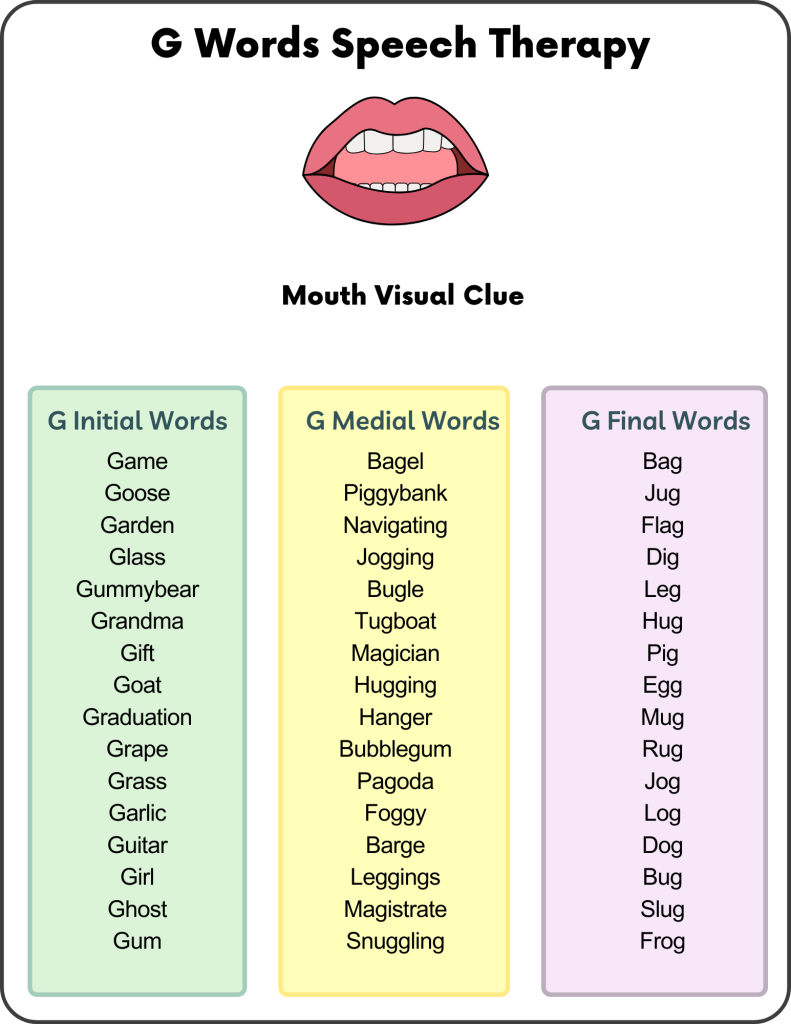
G Words Speech Therapy Printable PDF Worksheet
Understanding G Word Positions
- Initial G Words: These begin with G, like “game” or “goose,” where the sound starts with a robust, voiced burst.
- Medial G Words: These have G in the middle, such as “hanger” or “bugle,” blending G with other sounds.
- Final G Words: These end with G, like “bag” or “jug,” requiring a clear, voiced finish.
Lists of G Words for Practice
Here are kid-friendly hard-G word lists for home use, organized by position and syllable count. Start with the one-syllable words and build up as your child gains confidence
G Initial Words
One syllable: game, goose, go, get, girl, give, goat, gold, golf, good, gum, gun, gate, gas, gift, guy, guard, guess, guide, gap, gear, geese, ghost, gone, got, gown, gulf, guts Two syllables: garden, garage, garlic, gather, giggle, goggles, golden, goldfish, golfer, goodbye, goofy, google, gopher, gossip, govern, guitar, gumball, gummy, gutter, gadget, gallon, gallop Three or more syllables: gorilla, gasoline, gathering, government, gardener
G Medial Words
Two syllables: again, ago, agree, beggar, bagel, bigger, buggy, dragon, eagle, foggy, forget, hugging, juggle, magnet, soggy, sugar→(remove, /sh/), tiger, wagon, wiggle, yoga Three or more syllables: alligator, kangaroo, together
G Final Words
One syllable: dog, bug, pig, bag, egg, big, dig, dug, fog, frog, hug, jog, jug, leg, log, mug, peg, plug, rag, rug, tag, twig, wag, wig, fig Two syllables: bulldog, catalog, hotdog, iceberg, ladybug, zigzag
Practice Resources for the G Sound
Free printables and interactive practice for each word position.
Sounds That Are Often Confused With G
Is your child saying “D” instead of G (doat for goat)?
This is the most common G difficulty, and it has a name: fronting. G is a “back sound,” made by lifting the back of the tongue, while D is a “front sound,” made by tapping the tongue tip behind the teeth. When a child hasn’t yet learned to lift the back of the tongue, they reach for the easier front sound — so “goat” becomes “doat” and “go” becomes “doe.” The encouraging news is that fronting usually responds well to practice that helps the child lift the back of the tongue while keeping the tip down. A gentle “gargle” sound, or pretending to be a growling bear, can help your child find the G spot. See our complete D words list to practice the contrast.
Is your child mixing up G and K?
The G and K sounds are made in exactly the same place — both lift the back of the tongue to the roof of the mouth, near the throat. The only difference is the voice: G is “switched on” and makes the throat buzz, while K is quiet, just a puff of air. Because they’re so similar, children sometimes blur the two, saying “kum” for “gum” or the other way around. A simple trick is to have your child rest a hand on their throat — it buzzes for G and stays still for K. In fact, if your child can already say K, they’re most of the way to G; they just need to add the voice. See our complete K words list.
Tips for Parents to Support Practice
Here’s how to help your child with G words at home:
Find the Back: Because G is made at the back of the mouth, your child can’t see where the tongue goes — so it helps to give them a way to feel it. A gentle gargle (with a tiny sip of water, or just pretending) naturally lifts the back of the tongue into the G position, as does making a low growl like a bear or a tiger. Once they’ve felt that back-of-the-tongue lift, ask them to turn it into a “guh.” Keeping the tongue tip resting down behind the bottom teeth helps stop it from sneaking forward into a “D.”
Borrow from K: G and K are made in exactly the same spot — the only difference is the voice. If your child can already say “K,” you have a shortcut: have them say a strong “K,” then do it again with the voice turned on to feel it become “G.” Resting a hand on the throat makes this obvious — it stays quiet for K and buzzes for G. This “same spot, add the voice” trick is often the fastest way in.
Model the Voice: Children learn sounds by copying what they hear, so model the G clearly, emphasizing that little voiced burst — “G-g-game.” Make sure your own voice is switched on so your child hears the buzz that makes it a G rather than a K. Say it slowly and let them watch and listen, then cheer every good try. Warm encouragement keeps a child motivated to keep practicing a tricky back sound.
Add Actions: Linking a G word to a movement gives your child an extra way to remember it and makes practice playful. Pair “go” with running in place, “dog” with a bark, “gate” with opening an imaginary gate, or “goat” with a little head-butt. The action gives the word meaning and turns repetition into a game. Over time your child may start the movement and the word together, which is a great sign the sound is becoming automatic.
Start Where It’s Easy: Some children find G easier at the end of words (“dog,” “bug,” “pig”) and others at the beginning (“go,” “game”) — follow your child’s lead. Begin with whichever position they can do well, build up their confidence with lots of successful repetitions, then move to the harder spot. Success breeds success, so it’s better to start easy and grow than to push a position that’s frustrating.
If your child swaps G for D (e.g., “doat” for “goat”) or drops final G (e.g., “do” for “dog”), a speech therapist can help adjust tongue placement. Steady, playful practice at home makes a real difference between sessions.
If your child swaps G for D (e.g., “doat” for “goat”) or drops final G (e.g., “do” for “dog”), a speech therapist can help adjust tongue placement.
The G sound is a great goal for clear speech, and you’re set to help your child master it! With these G initial, medial, and final word lists and easy home tips, practice can be a blast. Keep it fun and steady, and don’t hesitate to seek a professional if needed—your support is golden for their words!
G Words FAQs
Why does my child say “D” instead of “G” (doat for goat)?
This is called fronting — replacing the back G sound with the easier front D sound. It’s very common in toddlers. Helping your child lift the back of the tongue (a gentle gargle or a growl works well) usually resolves it with practice.
What are the easiest G words to start with?
Short, one-syllable words are best — and many children find final-G words like “dog,” “bug,” and “pig” easier than initial-G words like “go” and “game.” Start where your child has success.
Why does the letter G sometimes sound like J?
The letter G has two sounds: a “hard G” (as in “go” and “game”) and a “soft G” that sounds like J (as in “giraffe” and “gem”). This page is about the hard G sound — soft-G words are practiced with the J sound.
What sounds are related to G?
K is G’s voiceless partner (same mouth position, without the voice), and D is the sound children most often substitute for G (“doat” for “goat”). Practicing G alongside these related sounds helps children hear and feel the differences.