K Words in Speech Therapy
November 19, 2025
G Words in Speech Therapy
November 19, 2025Introduction to N Words in Speech Therapy
Hello, parents! If your child is having difficulty with the N sound, this guide is here to assist you. The N sound—a voiced alveolar nasal made by pressing the tongue tip against the upper ridge behind the teeth and letting air flow through the nose—is typically mastered by age 3-4, but some kids may substitute it with “D” (e.g., “dose” for “nose”) or struggle with its nasal quality. This article provides lists of N initial, medial, and final words, plus practical tips to make practice enjoyable and effective at home, empowering you to support your child’s speech development.
What makes N special is that it’s a nasal sound — the air comes out through the nose, not the mouth. A quick and fun way to check it is to have your child hold a finger lightly on the side of the nose while humming “nnn” — they’ll feel it buzz. That nasal buzz is the heart of the N sound, and it’s the main thing that separates it from “D,” which sends the air out through the mouth instead.
On this page you’ll find a complete, organized list of N words — grouped by position and syllable count so you can start simple and build up — along with free printable worksheets, games, and a plain-language explanation of the sounds most often confused with N. New to teaching this sound? Start with our full guide on how to teach the N sound, then come back here for the word lists and practice resources.
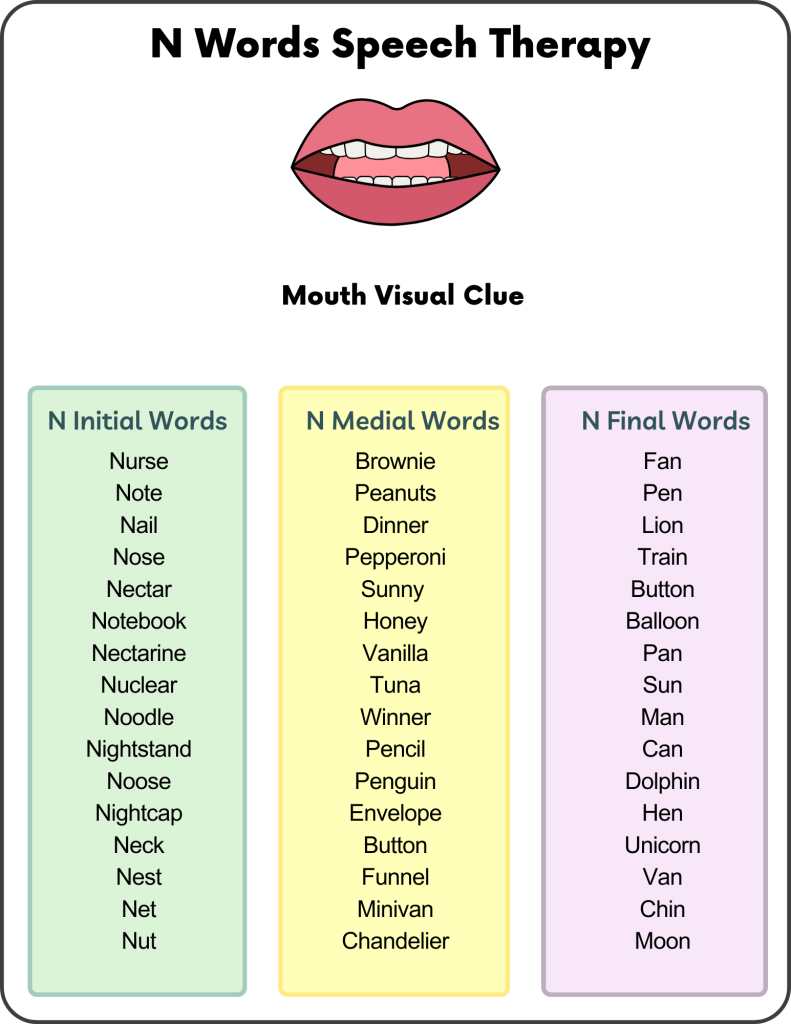
N Words Speech Therapy Printable PDF Worksheet
Understanding N Word Positions
- Initial N Words: These begin with N, like “nose” or “nest,” where the sound starts with a clear, nasal hum.
- Medial N Words: These have N in the middle, such as “sunny” or “brownie,” blending N with other sounds.
- Final N Words: These end with N, like “fan” or “pen,” requiring a strong nasal finish.
Lists of N Words for Practice
Here are kid-friendly N word lists for home use, organized by position and syllable count. Start with the one-syllable words and build up as your child gains confidence.
N Initial Words
One syllable: nose, nest, net, nut, no, name, nap, near, neat, neck, need, new, news, next, nice, night, nine, nod, noise, none, noon, north, note, now, numb, nurse
Two syllables: nachos, napkin, narrow, nasty, nation, native, nature, naughty, navy, nearby, needle, neighbor, nephew, nervous, nickel, nickname, nighttime, ninja, nobody→(3), noisy, noodle, normal, notebook, nothing, notice, novel, number, nutmeg
Three or more syllables: navigate, negative, newspaper, nowadays, nursery, nobody
N Medial Words
Two syllables: any, bunny, canoe, dinner, funny, honey, manner, minute, money, monkey, peanut, penny, pony, rainbow, runner, sunny, tennis, tiny, tuna, winner, winter, banana→(3), brownie
Three or more syllables: animal, banana, dinosaur, elephant, piano
N Final Words
One syllable: fan, pen, sun, moon, ten, man, can, run, win, bean, been, bin, bone, brown, bun, chin, clean, coin, corn, down, fin, fun, green, gun, hen, in, lawn, mean, on, pain, pan, phone, pin, plane, rain, thin, town, train, van Two syllables: apron, bacon, balloon, button, chicken, crayon, dragon, garden, kitchen, lemon, melon, muffin, ocean, oven, robin, wagon
Practice Resources for the N Sound
Free printables and interactive practice for each word position.
Sounds That Are Often Confused With N
Is your child saying “D” instead of N (dose for nose)?
N and D are made in exactly the same spot — the tongue tip taps the ridge just behind the top front teeth. The only difference is where the air goes: N sends it out through the nose (a nasal hum), while D sends it out through the mouth (a quick tap). When a child directs the air through the mouth instead of the nose, “nose” comes out as “dose” and “note” as “dote.” The fix is very tactile — have your child hold a finger on the side of the nose during a long “nnn” so they can feel the buzz, showing them that the air should hum through the nose. See our complete D words list to practice telling the two apart.
How does N compare to M?
N and M are both nasal sounds — the air hums out through the nose in both. The difference is how they’re made: M is made with the lips together, while N is made with the tongue tip up behind the teeth. Some children mix them up, saying “noon” for “moon” or the reverse. Practicing them side by side — “lips together for M, tongue up for N” — helps your child feel the difference. See our complete M words list.
Tips for Parents to Support Practice
Here’s how to help your child with N words at home:
Hum the Nasal: N is a nasal sound, so help your child feel the buzz in the nose. Have them hum a long “nnn” like a gentle sniff while resting a finger lightly on the side of the nose — they’ll feel it vibrate. Point to your own nose as you do it, so they connect the buzz with where the sound comes from. That nasal hum is the key that separates N from D, so getting your child to feel it is half the battle.
Blend into Chat: Practice sticks best when it happens naturally, so weave N words into everyday talk and play. Say things like “Run to the sun!”, “Where’s your nose?”, or “Time for a nap” during ordinary moments. When the sound comes up in real conversation, gently stretch the “nnn” so your child hears a clear model. This low-key repetition helps the sound carry over into their everyday speech far better than isolated drills.
Repeat with Fun: A little repetition builds the muscle memory, and pairing it with an action keeps it playful. Say “nut, nut, nut” while pretending to crack one open, or “night-night” while tucking in a toy. The rhythm and movement make the repeats feel like a game rather than a drill. Aim for lots of quick, cheerful repetitions rather than a few careful ones.
Model the Sound: Children learn sounds mainly by copying, so model N clearly, stretching it out — “N-n-nest.” Let your child watch and listen, and make sure the sound hums through your nose so they hear that nasal quality. A mirror can help them see the tongue lift behind the top teeth. Celebrate every good try, since encouragement keeps them motivated to keep practicing.
Pair with Objects: Linking a word to a real object gives your child something concrete to connect the sound to. Point to a toy net and say “net,” or look up at the night sky and say “moon,” or hand them a napkin at dinner. Touching or seeing the object as they say the word makes practice meaningful and memorable. Rotating through favorite objects keeps them engaged and gives lots of natural repetitions.
If your child swaps N for D (e.g., “kote” for “note”) or skips final N (e.g., “moo” for “moon”), a speech-language pathologist can offer tailored advice. A note for parents: because N depends on nasal airflow, a stuffy nose from a cold or allergies can temporarily make it sound like a D.
The N sound is a natural part of clear speech, and you’re well-equipped to help your child master it! With these N initial, medial, and final word lists and easy home tips, practice can be both fun and fruitful. Keep it consistent and playful, and don’t hesitate to seek a professional if needed—your support makes a notable difference!
N Words FAQs
Why does my child say “D” instead of “N” (dose for nose)?
N and D are made in the exact same spot — the difference is that N sends the air through the nose while D sends it through the mouth. Having your child feel the nasal buzz with a finger on the side of the nose during a long “nnn” usually helps.
At what age should my child say the N sound?
N is one of the earliest sounds to develop, usually by age 2 to 3. If a child isn’t using it by age 3, it’s worth mentioning to a speech-language pathologist.
Why does my child’s N sound stuffy?
Because N relies on air flowing through the nose, a stuffy nose from a cold or allergies can temporarily make it sound more like a D. If speech sounds “blocked up” even when your child is well, it’s worth mentioning to a doctor or SLP.
What sounds are related to N?
N is closely related to D (same tongue spot, but N is nasal) and M (both are nasal sounds, but M uses the lips). Practicing N alongside these helps children hear and feel the differences.