V Words in Speech Therapy
November 19, 2025
N Words in Speech Therapy
November 19, 2025Introduction to K Words in Speech Therapy
Hello, parents! If your child is working on the K sound, this guide is for you. The K sound—a voiceless velar stop made by raising the back of the tongue to the soft palate and releasing it without voice—is typically mastered by age 4, but some kids substitute it with “T” (e.g., “tat” for “cat”) due to its back-of-the-mouth placement. This article offers lists of K initial, medial, and final words, plus practical tips to make practice enjoyable and effective at home, empowering you to help your child’s speech take off.
The K sound is one of the trickier early sounds precisely because you can’t see it. Lip sounds like “p” and “b” are easy for a child to copy in a mirror, but K happens at the back of the mouth, out of sight — so a child often needs a little extra help discovering where their tongue should go. That’s completely normal, and with the right cues and some playful, regular practice at home, most children pick it up steadily.
On this page you’ll find a complete, organized list of K words to practice — grouped by position and by how many syllables they have, so you can start simple and build up — along with free printable worksheets, games, and a plain-language explanation of the sounds that are most often confused with K. New to teaching this sound? Start with our full guide on how to teach the K sound, which walks through exactly how to help your child produce it. Then come back here for the word lists and practice resources.
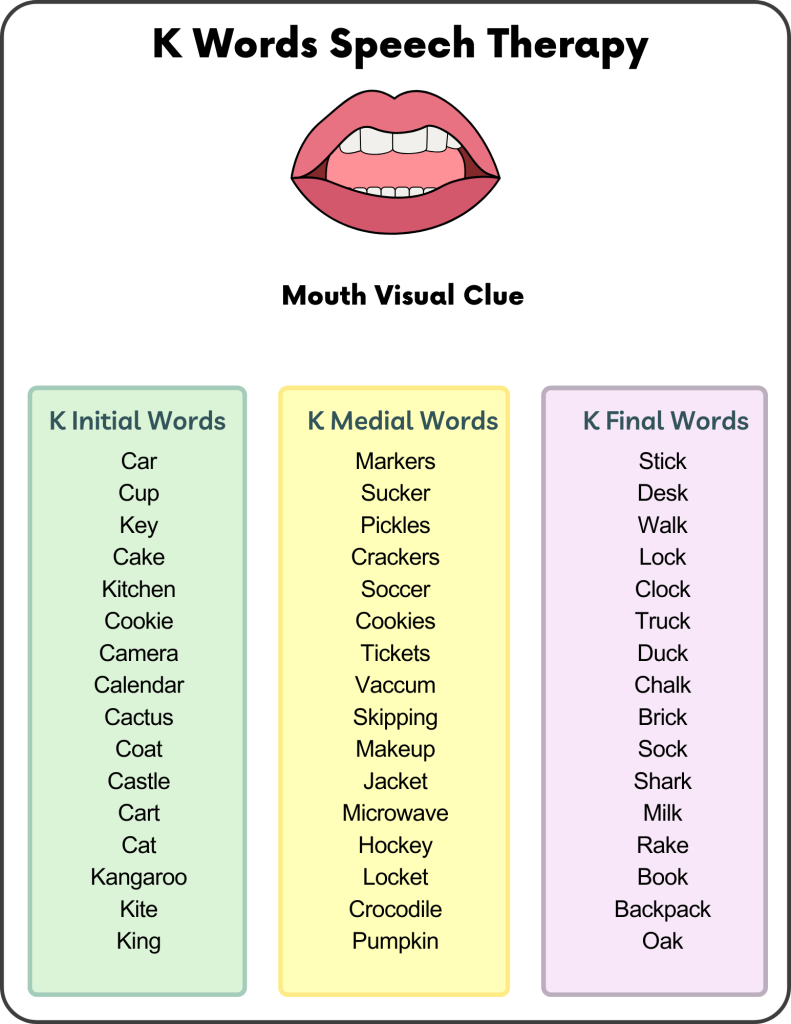
K Words Speech Therapy Printable PDF Worksheet
Understanding V Word Positions
- Initial K Words: These begin with K, like “cat” or “kite,” where the sound starts with a crisp, voiceless burst.
- Medial K Words: These have K in the middle, such as “marker” or “pickles,” blending K with other sounds.
- Final K Words: These end with K, like “book” or “duck,” requiring a clear, voiceless finish.
Lists of V Words for Practice
Here are kid-friendly K word lists for home use, organized by position and syllable count. Start with the one-syllable words and build up to the longer ones as your child gains confidence.
K Initial Words
One syllable: car, cup, key, cake, coat, cart, cat, kite, king, cab, cage, call, camp, can, cane, cap, card, care, case, cash, cave, coal, coin, cold, comb, cone, cook, cool, cop, corn, cough, count, cow, cub, curl, cut, kick, kid, kind, kiss, kit
Two syllables: kitchen, cookie, cactus, castle, cabbage, cabin, candle, candy, canyon, carpet, carrot, catfish, ketchup, kitten, koala, cotton, cousin, cupcake, curtain, cushion
Three or more syllables: camera, calendar, cantaloupe, caterpillar, computer, cucumber, kangaroo, kindergarten
K Medial Words
Two syllables: markers, sucker, pickles, crackers, soccer, cookies, tickets, vacuum, skipping, makeup, jacket, hockey, locket, pumpkin, bacon, napkin, pancake, pocket, raccoon, rocket, second, sticker, turkey
Three or more syllables: microwave, crocodile, broccoli, chocolate, macaroni, motorcycle, recorder, telescope, watermelon
K Final Words
One syllable: stick, desk, walk, lock, clock, truck, duck, chalk, brick, sock, shark, milk, rake, book, oak, back, bake, beak, bike, cheek, chick, cook, deck, hawk, hook, lake, leak, lick, look, luck, make, neck, peek, pick, sick, snake, take, thick, week
Two syllables: backpack, attack, notebook, pancake, seasick
Free printables and interactive practice for each word position.
Sounds That Are Often Confused With K
Is your child mixing up K and G?
The K and G sounds are made in exactly the same place — both lift the back of the tongue toward the roof of the mouth, near the throat. The only difference is the voice: K is quiet, just a puff of air, while G is “switched on” and makes the throat buzz. Because they’re so similar, children often blur the two, saying “coat” for “goat” or the other way around. A simple trick is to have your child rest a hand on their throat — it stays still for K and vibrates for G. Practicing the two sounds side by side helps your child hear and feel that difference. See our complete G words list.
Is your child saying “T” instead of K (tat for cat)?
This is the most common K difficulty, and it has a name: fronting. K is a “back sound,” made by lifting the back of the tongue, while T is a “front sound,” made by tapping the tongue tip behind the teeth. When a child hasn’t yet learned to lift the back of the tongue, they reach for the easier front sound — so “cat” becomes “tat” and “key” becomes “tea.” The encouraging news is that fronting usually responds well to practice that helps the child draw the tongue tip down and lift the back up. A gentle cough, or lying on their back so gravity pulls the tongue backward, can help them find the K spot. See our T words list to practice the contrast between the two.
Tips for Parents to Support Practice
Here’s how to help your child with K words at home:
Feel the Back: Because K is made at the back of the mouth, it can be hard for a child to know where their tongue should go — they can’t see it the way they can see lip sounds. Try having your child cough lightly; that little cough is actually a K sound, so it’s a great way to help them feel the back of the tongue lifting. Once they’ve found that spot, ask them to hold it and turn it into a “kuh.” Doing this in front of a mirror can make the invisible feel a little more concrete.
Blend into Fun: Practice sticks best when it doesn’t feel like practice. Weave K words naturally into whatever your child is already doing — “Kick the ball,” “Let’s find the cookie,” “Look at the kite.” During play, narrate the action with K words so the sound comes up again and again without any pressure. Kids stay motivated far longer when the practice is folded into a game they’re enjoying than when it feels like a drill.
Repeat with Rhythm: Repetition is what builds the muscle memory for a new sound, but plain repetition gets boring fast. Add a beat or a movement — chant “cup, cup, cup” while stacking real cups, or “kick, kick, kick” while marching. The rhythm makes the repeats feel like a game, and pairing the word with an action helps your child remember it. Aim for lots of quick, cheerful repetitions rather than a few careful ones.
Model the Burst: Children learn sounds largely by copying what they hear, so clear modeling matters. Say the K sound crisply, exaggerating the little burst of air — “K-k-key” — so your child can hear exactly what they’re aiming for. Keep your voice off during the K itself, since it’s a quiet sound, so they don’t accidentally turn it into a G. And celebrate every good try, even the close ones — encouragement keeps them wanting to practice.
Add Actions: Linking a sound to a movement gives your child an extra way to remember it and makes practice more playful. Pair “cake” with pretend baking, “duck” with a waddle and a quack, or “car” with driving a toy around. The action gives the word meaning and makes the whole thing feel like play rather than work. Over time, your child will often start the action and the word together, which is a great sign the sound is becoming automatic.
Start at the End: Many children find the K sound easier at the end of words before the beginning. If “cat” and “key” are frustrating, try final-K words first — “book,” “duck,” “back,” “rock.” Success with these builds confidence and helps your child feel the sound before tackling the harder initial position. Once final K feels steady, initial K often comes more easily.
If your child swaps K for T (e.g., “tat” for “cat”) or skips final K (e.g., “boo” for “book”), a speech therapist can offer strategies to adjust tongue placement.
The K sound is a cool step toward clear speech, and you’re ready to help your child master it! With these K initial, medial, and final word lists and easy home tips, practice can be a kick. Keep it fun and steady, and don’t hesitate to seek a professional if progress lags—your support is key to their success!
K Words FAQs
What are the easiest K words to start with?
Short, one-syllable words are best to begin with — and many children find final-K words like “book,” “duck,” and “back” easier than initial-K words like “key” and “cat.” Start where your child has success and build from there.
How many K words should we practice at once?
A small handful — about 5 to 10 words per short session — repeated a few times a day works better than one long drill. Consistency matters more than length.
Why are some K words spelled with a “c”?
The K sound can be spelled with a “k” (key, kite), a “c” (cat, cup), or “ck” (duck, back). They all make the same sound, so all of them are good K practice — it’s the sound that matters, not the letter.
What sounds are related to K?
G is K’s voiced partner (same mouth position, with the voice on), and T is the sound children most often substitute for K (“tat” for “cat”). Practicing K alongside these related sounds helps children hear and feel the differences.