Flashcards
Initial K Sound Words for Speech Therapy
Free initial K sound words for Speech Therapy printable flashcards featuring words with the "K" sound can be a useful tool for improving pronunciation and vocabulary. Some of the flashcards included in this worksheets are:- car, cup, key, cake, cat, kangaroo, kite, king, kitchen, cactus, camera, cookie, castle and coat.
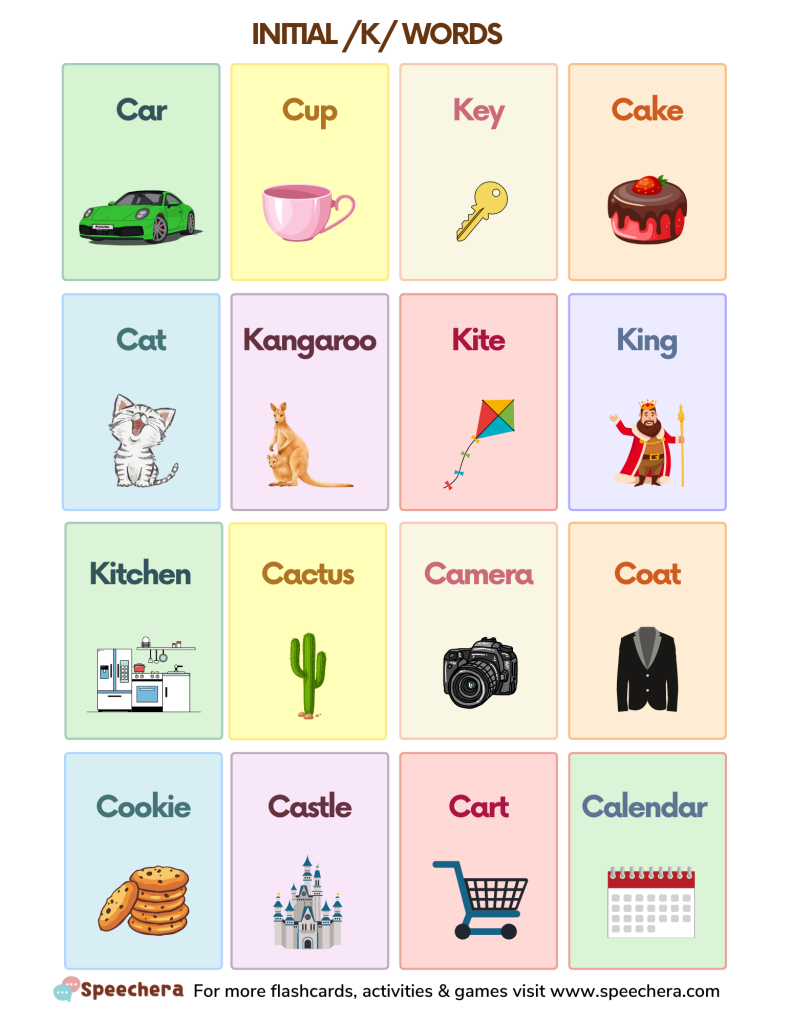
Initial K Words for Speech Therapy
Looking for initial K words to practice at home or in therapy? This page has the biggest list of K words that start with the /k/ sound on our site — organized by syllable, by theme, and as simple CVC words — plus a free printable worksheet, interactive audio flashcards, and a memory game. The /k/ sound is a “back sound,” made by lifting the back of the tongue to the roof of the mouth. Note: the K sound is spelled both “k” (key, kite) and “c” (cat, cup), and both are good K practice.
Working on the K sound in the middle and end of words too, or want to know how to teach it? See our complete K words guide, or our guide on how to teach the K sound.
Initial K Words by Syllable
Start with 1-syllable words and build up as your child gains confidence. (The K sound can be spelled “k” or “c”.)
1 syllable: key, cat, car, cup, cake, cow, coat, cold, coin, corn, comb, cane, cap, card, care, cart, case, cash, cave, coal, cone, cook, cool, cop, cord, cough, count, court, cub, curl, cut, kick, kid, kind, king, kiss, kit, kite, call, calm, camp, can
2 syllables: candy, carrot, kitchen, kingdom, keyboard, kitty, ketchup, keeper, kiwi, cactus, cabin, cabbage, candle, cartoon, cookie, cotton, cousin, cupcake, curtain, cushion, koala, karate, kindle
3+ syllables: calendar, camera, cantaloupe, caterpillar, computer, cucumber, kangaroo, kindergarten, coconut
Initial K Words by Theme
Practicing around a child’s interests keeps them motivated. Pick a theme they love.
Animals: cat, cow, cub, kitten, koala, kangaroo, calf
Food: cake, candy, carrot, cookie, cupcake, ketchup, coconut, cantaloupe, kiwi
Actions: kick, kiss, cook, count, cut, call, catch, climb
Around the house / things: key, car, cup, coat, card, comb, candle, kite, keyboard, curtain, cushion
Initial K CVC Words (great for early readers)
CVC (consonant-vowel-consonant) words are the simplest structure — perfect for beginners and early literacy.
cat, cab, can, cap, cop, cup, cut, cod, cot, kid, kit, kin, keg, cog
How to Use This List
Start simple and build up in steps — the same progression a therapist uses:
- Isolation: make sure your child can make the /k/ sound on its own — lift the BACK of the tongue and release a quick burst of air (no voice). A gentle cough is basically a K, so it’s a great way to find the spot. (Our how-to-teach guide walks through this.)
- Words: practice the 1-syllable words above, a small handful at a time.
- Carrier phrases: drop the words into a simple repeated phrase (below) to build toward sentences.
- Games & play: use the memory game and activities below to make practice fun and get lots of repetitions.
Short, playful, and frequent beats long and serious — a few minutes a few times a day is ideal.
Initial K Carrier Phrases
Once single words are steady, practice them in a simple, repeatable phrase. Just swap in a new K word each time:
- “I see a ___.” (cat, cow, key…)
- “I want the ___.” (cookie, candy, cake…)
- “It’s a ___.” (cool car, cute kitten…)
- “Kick the ___.” / “Cook the ___.” (ball / corn)
- “Where’s the ___?” (key, cup, coat…)
Carrier phrases are the bridge between single words and full sentences — the same word, said many times, inside a tiny sentence frame.
Fun Initial K Activities
- Coughing Sound: A gentle little cough is basically a K — have your child cough softly, then turn it into “kuh.” It’s a great way to find the back-of-the-tongue spot.
- Lie Back & Say K: Have your child lie on their back and say K words — gravity gently pulls the tongue backward, which helps find the K placement (a trick therapists use).
- K Scavenger Hunt: Find things that start with K — a key, a cup, a car, a coat. Say each with a crisp “kuh!”
- Kitchen Play: A pretend kitchen is full of K words — cook, cup, cake, carrot, cookie. Say each as you play.
- K Actions: Pair “kick” with kicking, “kiss” with a kiss, “count” with counting — movement plus sound.
Hear the words, play a game, and explore more K practice.
Ways to Use the Printable Worksheet
The free printable above is flexible — a few ideas:
- Print and practice: work down the list, giving a star or sticker for each good try.
- Make flashcards: cut the pictures/words apart to use as flashcards.
- Play memory: print two copies, cut them out, and match pairs.
- Go Fish: use the pairs for a game of Go Fish, saying each K word as you play.
Initial K Words FAQs
What are the easiest initial K words to start with?
Short, one-syllable words are best — “key,” “cat,” “car,” and “cup.” Some children find final-K words like “book” and “duck” a little easier first, then move to the beginning.
Why does my child say “T” instead of “K” (tat for cat)?
This is called fronting — replacing the back K sound with the easier front T sound. Helping the child lift the back of the tongue (a gentle cough, or lying on their back so gravity helps) usually resolves it with practice.
Why are some K words spelled with a “c”?
The K sound can be spelled with a “k” (key, kite), a “c” (cat, cup), or “ck” (duck, back). They all make the same sound, so all of them are good K practice — it’s the sound that matters, not the letter.
At what age should my child say the K sound?
Most children produce the /k/ sound correctly by age 3 to 4. Substituting T for K is normal in toddlers, but if it continues past age 4 it’s worth checking with a speech-language pathologist.