S Words in Speech Therapy
November 18, 2025
V Words in Speech Therapy
November 19, 2025Introduction to T Words in Speech Therapy
Hello, parents! If your child is having difficulty saying the T sound, this guide is here to help. The T sound—a voiceless alveolar stop made by pressing the tongue tip against the upper ridge behind the teeth and releasing it without voice—is typically mastered by age 4, but some kids may substitute it with “D” (e.g., “dop” for “top”) or struggle with its crispness. This article provides lists of T initial, medial, and final words, plus practical tips to make practice fun and effective at home.
The T sound is a quick, crisp “tap” — the tongue tip touches the ridge behind the top front teeth and pops off with a little puff of air, and no voice. A fun way to practice is to make it sound like a ticking clock (“t-t-t-t”) or drops of water (“tick, tick”). The most common T slip-up is saying “D” instead (“dop” for “top”), which happens when the voice gets switched on by mistake — so the cue “keep it quiet and crisp” usually helps.
On this page you’ll find a complete, organized list of T words — grouped by position and syllable count so you can start simple and build up — along with free printable worksheets, games, and a plain-language explanation of the sounds most often confused with T. New to teaching this sound? Start with our full guide on how to teach the T sound, then come back here for the word lists and practice resources.
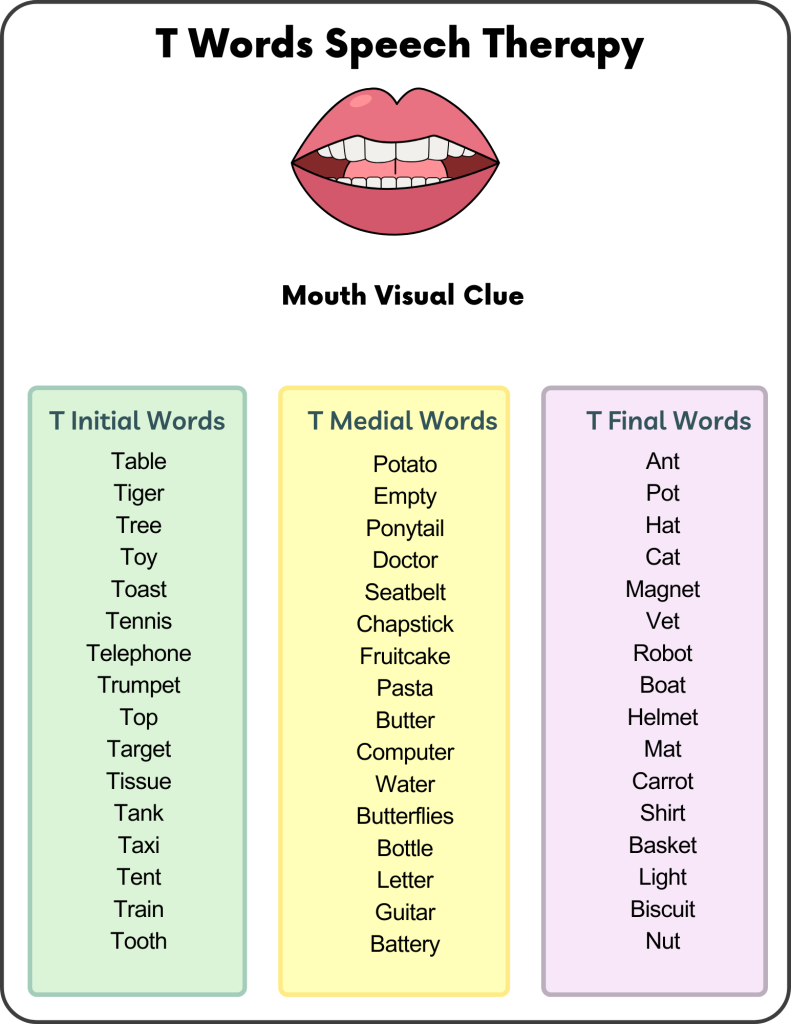
T Words Speech Therapy Printable PDF Worksheet
Understanding T Word Positions
- Initial T Words: These begin with T, like “top” or “toy,” where the sound starts with a sharp, voiceless pop.
- Medial T Words: These have T in the middle, such as “butter” or “water,” blending T with other sounds.
- Final T Words: These end with T, like “cat” or “hat,” requiring a clean, voiceless finish.
Lists of T Words for Practice
Here are kid-friendly T word lists for home use, organized by position and syllable count. Start with the one-syllable words and build up as your child gains confidence.
T Initial Words
One syllable: top, toy, ten, two, toe, tie, tea, tan, tag, tail, take, talk, tall, tape, team, teeth, tell, tent, test, tick, time, tin, tip, toad, toast, tool, tooth, tow, tub, tug, town, tour
Two syllables: table, tablet, taco, tadpole, taxi, teacher, teapot, teddy, tennis, tiger, tiny, tissue, title, toaster, today, tomato→(3), tongue, tornado→(3), towel, tower, toolbox, turkey, turtle, tuxedo, target, tulip
Three or more syllables: telephone, television, tomato, tornado, telescope, tarantula, temperature
T Medial Words
Two syllables: butter, water, letter, kitten, mitten, cotton, city, fifty, guitar, motor, patter, photo, pilot, potato→(3), pretty, rotten, writer, otter, litter, matter, better, batter
Three or more syllables: attention, beautiful, computer, important, potato, waterfall, dinosaur, alligator, caterpillar
T Final Words
One syllable: cat, hat, bat, bit, boat, boot, coat, cut, dot, feet, foot, gate, goat, hot, jet, kite, light, mat, meat, net, nut, pat, pet, pot, rat, seat, set, sit, wet, hit, out, night, right
Two syllables: basket, biscuit, blanket, bucket, carrot, closet, cricket, jacket, magnet, market, parrot, planet, pocket, rabbit, rocket, ticket, trumpet, violet, robot, comet, helmet, peanut
Practice Resources for the T Sound
Free printables and interactive practice for each word position.
Sounds That Are Often Confused With T
Is your child saying “D” instead of T (dop for top)?
T and D are made in exactly the same spot — the tongue tip taps the ridge behind the top front teeth. The only difference is the voice: T is quiet (just a puff of air), while D is “switched on” and buzzes. When a child turns the voice on by mistake, “top” comes out as “dop” and “two” as “do.” The fix is easy to feel: have your child rest a hand on their throat — it stays still for T and buzzes for D. Practicing word pairs like “top/dop” and “two/do” side by side helps them hear that the voice changes the word. See our complete D words list to practice the contrast.
Is your child using T instead of K (tat for cat)?
Sometimes it’s the other way around — the child says T when they mean K, so “cat” becomes “tat” and “key” becomes “tea.” This is called fronting: K is a “back sound” (the back of the tongue lifts), but T is a “front sound,” so a child who can’t yet lift the back of the tongue substitutes the easier front T. If this is what you’re hearing, the work is usually on the K sound itself. See our complete K words list for help with the contrast.
Tips for Parents to Support Practice
Here’s how to help your child with T words at home:
Tap It Out: T is a quick, crisp tap — the tongue tip touches the ridge behind the top teeth and pops off with a little puff of air. Help your child feel that pop by holding a hand in front of the mouth as they say “t-t-t.” Compare it to a ticking clock or dripping water to give them a fun picture. Keeping it short and crisp (not drawn out) is what makes a clean T.
Keep It Quiet: The main thing that separates T from D is the voice — T is quiet, D buzzes. If your child says “dop” for “top,” have them rest a hand on the throat and notice that it should stay still for T. Cue them with “make it quiet and crisp.” Feeling the difference between the quiet T and the buzzy D is usually the key to fixing the mix-up.
Play with Word Pairs: Because “D for T” is the most common slip, minimal pairs are a great tool. Say pairs like “top/dop,” “two/do,” and “tie/die,” and play up how the sound changes the word — “Did you say TWO, or DO?” This helps your child notice that the quiet T and the buzzy D are different on purpose. Keep it light and silly, and they’ll happily practice the contrast.
Weave It into the Day: T shows up constantly in everyday words, so practice happens naturally if you look for it — “Time for your toys,” “Put on your hat,” “Look at the turtle.” When the sound comes up, gently emphasize a crisp “t” so your child hears a good model. This low-key repetition helps the sound carry over into real speech. Mealtimes and getting dressed are full of T words to catch.
Watch the Final T: The T at the end of words like “cat,” “hat,” and “foot” is easy to drop or soften, especially in fast speech. Give final-T words a little extra attention, exaggerating the crisp tap at the end and having your child pop it clearly. Clapping or tapping the table on the final T can help mark it. A clear final T makes a big difference in how well others understand your child.
IIf your child continues to struggle with the T sound after practice, consider seeking help from a speech therapist for personalized guidance.. The T sound is a doorway to clear speech, and you’re ready to help your child master it! With these T initial, medial, and final word lists and easy home tips, practice can be a delight. Keep it steady and playful, and don’t hesitate to seek a professional speech therapist if needed.
T Words FAQs
Why does my child say “D” instead of “T” (dop for top)?
T and D are made in the exact same spot — the only difference is the voice. Saying “dop” for “top” (called voicing) means the voice got switched on by mistake. Have your child rest a hand on the throat to feel that T stays quiet while D buzzes.
At what age should my child say the T sound?
T is an early sound, usually mastered by around age 3 to 4. If a child is still substituting it past age 4, it’s worth checking with a speech-language pathologist.
What are the easiest T words to start with?
Start with short one-syllable words like “top,” “toe,” “tie,” and “ten,” where the T is at the beginning and easy to hear. Some children find final-T words like “cat” and “hat” easy too.
What sounds are related to T?
T is the voiceless partner of D (same spot, but T is quiet) and the sound children often substitute for K (“tat” for “cat”). Practicing T alongside D and K helps children hear and feel the differences.