L Words in Speech Therapy
November 18, 2025
T Words in Speech Therapy
November 19, 2025Introduction to S Words in Speech Therapy
Welcome, parents! If your child is working on the S sound—pronounced as in “sit” or “sun”—you’re in the right place. The S sound is a voiceless alveolar fricative, which means it’s a long, quiet hiss made by letting a thin stream of air flow over the tongue, with no voice. It’s usually mastered by children between ages 5 and 6. Some children substitute it with other sounds like “th” or “sh,” or they may have a lisp. This article provides lists of S words in initial, medial, and final positions and offers tips to help your child practice at home.
The most common S difficulty is a lisp, and it helps to know there are a few different kinds. A frontal lisp happens when the tongue pokes out between the front teeth, turning “s” into a “th” — so “sun” comes out as “thun.” A lateral lisp sounds a little slushy, because the air escapes over the sides of the tongue instead of straight down the middle. And some children “stop” the sound, replacing the long hiss with a quick “t” (saying “tun” for “sun”). Knowing which pattern you’re hearing makes it easier to choose the right practice.
A helpful way to think about S is the “snake sound” — a long, smooth “ssss” with the teeth gently together and a little smile. On this page you’ll find a complete, organized list of S words, grouped by position and syllable count so you can start simple and build up, along with free printable worksheets, games, and a plain-language explanation of the sounds most often confused with S. New to teaching this sound? Start with our full guide on how to teach the S sound, then come back here for the word lists and practice resources.
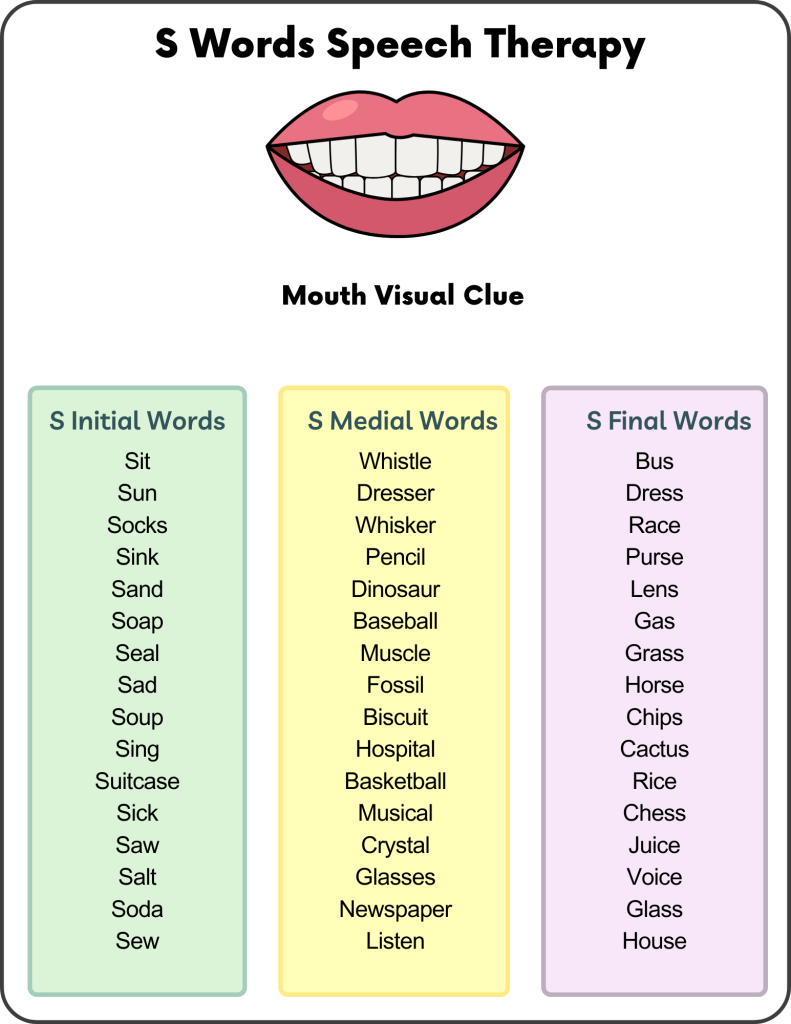
S Words Speech Therapy Printable PDF Worksheet
Understanding S Word Positions
- Initial S Words: These begin with S, like “sit” or “sun,” where the word starts with a long, smooth hiss.
- Medial S Words: These have S in the middle, such as “whistle” or “dresser,” blending S with surrounding sounds.
- Final S Words: These end with S, like “bus” or “dress,” requiring a clear, hissing finish.
Lists of S Words for Practice
Here are kid-friendly S word lists for home use, organized by position and syllable count. Start with the one-syllable words and build up as your child gains confidence..
S Initial Words
One syllable: sun, sock, sit, see, sea, soap, soup, sad, sail, salt, same, sand, save, saw, say, seal, seat, seed, self, sell, set, sew, sick, side, sign, sing, sink, sip, six, so, some, son, song, soon, sore, sort, sound, soup, sour, south, suit, sub, suck, sum, sung
Two syllables: sailor, salad, sandwich, second, seesaw, seven, silly, silver, simple, singer, sister, sixty, soccer, sofa, softball, someone, something, sunny, sunset, surfer, sausage, sunflower
Three or more syllables: sanitizer, satellite, saxophone, celebrate (soft c), centipede, secondary
S Medial Words
Two syllables: basket, bison, castle, glasses, lesson, messy, muscle, passing, pencil, recycle, tossing, whisper, dresser, faucet, baseball, outside, icing, sunset, listen
Three or more syllables: bicycle, dinosaur, medicine, messenger, popsicle, tricycle, eraser, ambassador
S Final Words
One syllable: bus, boss, bass, class, dress, face, gas, glass, grass, guess, ice, juice, kiss, less, mess, mouse, nice, pass, price, race, rice, this, us, yes, horse, house, dice, vase
Two syllables: address, campus, circus, cactus, octopus, walrus, lettuce, office, palace, purpose
Practice Resources for the S Sound
Free printables and interactive practice for each word position.
Sounds That Are Often Confused With S
Is your child saying “TH” instead of S (thun for sun)? — the frontal lisp
This is the most common S difficulty, called a frontal (or interdental) lisp. It happens when the tongue pokes out between the front teeth, so the air comes out over the tongue tip instead of behind the teeth — turning “sun” into “thun” and “sock” into “thock.” For a clear S, the tongue tip needs to stay just behind the top teeth (not poking out), with the teeth gently together and a little smile. A helpful cue is “keep your tongue behind your teeth and make the long snake sound.” In young children a mild frontal lisp can be developmentally normal for a while, but if it persists, targeted practice helps. See our complete TH words list to practice telling the two apart.
Is your child mixing up S and SH (sip vs ship)?
S and SH are close cousins — both are long, flowing air sounds — but the tongue and lips sit differently. For S, the tongue is forward and the lips are relaxed in a slight smile; for SH, the tongue pulls back and the lips round forward like a kiss. Some children blur the two, saying “sip” for “ship” or “ship” for “sip.” Practicing them side by side — “smile for S, fish-lips for SH” — helps your child feel the contrast. See our complete SH words list.
Tips for Parents to Support Practice
Here’s how to help your child with S words at home:
- Make the Snake Sound: The S sound is a long, smooth hiss, so give it a friendly name your child can picture — the “snake sound.” Have them make a long “ssss” like a snake, with the teeth gently together and a little smile, and see how long they can hold it on one breath. Because it’s a continuous sound, they can stretch it out, which makes it easy to feel and to notice if it goes wrong. Keeping the teeth close together and the tongue behind them is the key to a crisp S.
- Keep the Tongue Behind the Teeth: Most S trouble comes from the tongue slipping forward between the teeth, which turns “s” into “th.” Gently remind your child to keep the tongue tip hidden behind the top teeth — “tuck your tongue away” — and let the air whistle out in front. A mirror really helps here, because your child can see whether the tongue is poking out or tucked in. Catching and fixing that tongue position is often the whole game with S.
- Smile and Hiss: A slight smile naturally pulls the tongue into a good spot for S and helps direct the air down the middle. Have your child smile, put their teeth lightly together, and let a thin stream of air hiss out — you can even have them feel the cool air on their hand. Pairing “smile” with “hiss” gives them two simple things to remember. This small setup often turns a messy S into a clean one.
- Practice in Playful Words: Repetition works best when it’s fun, so build S practice into play. Use motivating words — “sun,” “snake,” “sock,” “soup” — and weave them into games, silly sentences, or everyday moments (“Let’s put on your socks,” “Look at the sun”). Storytelling with an S theme, like a “silly snake” adventure, gives lots of natural repetitions. The more playful and frequent the practice, the faster it carries over into everyday speech.
- Be Patient with Lisps: A mild lisp can be a normal part of development for a while, so patience matters. Keep practice short, warm, and encouraging, and celebrate close attempts rather than demanding a perfect S every time. If your child gets frustrated, step back to an easier word they can succeed with, then build up again. Steady, positive practice will get you much further than pressure.
If your child continues to substitute “th” or “sh” for S, or has a lisp that persists past around age six or seven, a speech-language pathologist can offer targeted guidance — a lateral (slushy) lisp in particular is worth having evaluated.
S Words FAQs
Why does my child say “th” instead of “s” (thun for sun)?
This is called a frontal lisp — the tongue pokes out between the front teeth instead of staying behind them. Cueing your child to “tuck the tongue behind the top teeth” and make a long “snake sound” helps. A mild lisp can be developmentally normal in younger children.
At what age should my child say the S sound?
Most children produce a clear S by age 5 to 6, though some are still refining it a little later. A lingering lisp past that age is worth discussing with a speech-language pathologist.
What are the easiest S words to start with?
Start with simple one-syllable words like “sun,” “sock,” “see,” and “soap,” where the S is at the beginning and easy to hear and hold.
What sounds are related to S?
S is closely related to TH (the frontal lisp swaps S for TH) and SH (“sip” vs “ship”). It’s also the voiceless partner of Z — same mouth position, but Z adds the voice. Practicing these together helps children hear the differences.