J Words in Speech Therapy
November 18, 2025
S Words in Speech Therapy
November 18, 2025Introduction to L Words in Speech Therapy
Welcome, parents! If your child is finding it difficult to pronounce “lake” or “lamp,” this guide is here to help. The L sound is a voiced alveolar lateral approximant — which means it’s a smooth, continuous sound made by touching the tongue tip to the ridge behind the top front teeth and letting the voice flow out around the sides of the tongue. It’s typically mastered by around age 5 or 6, but some children need extra practice to produce it correctly in all word positions.
The most common L difficulty is called gliding — replacing L with an easier “W” or “Y,” so “lion” comes out as “wion” or “yion,” and “leaf” as “weaf.” This is very common in young children and usually resolves with practice. The key cue is “smile and lift your tongue”: the smile keeps the lips from rounding into a “W,” and lifting the tongue tip to touch the “bump” behind the top teeth gives the L its clear sound. A mirror helps a lot, since your child can watch the tongue tip lift.
On this page you’ll find a complete, organized list of L words — grouped by position and syllable count so you can start simple and build up — along with free printable worksheets, games, and a plain-language explanation of the sounds most often confused with L. New to teaching this sound? Start with our full guide on how to teach the L sound, then come back here for the word lists and practice resources.
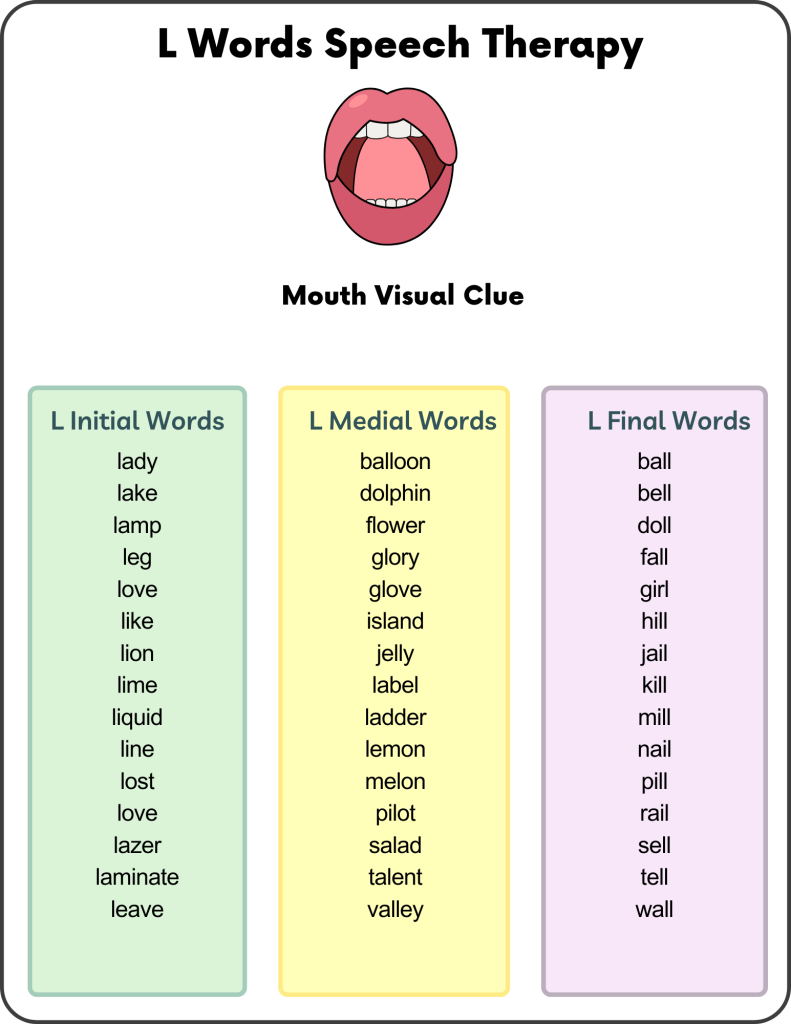
L Words Speech Therapy Printable PDF Worksheet
Understanding L Word Positions
- Initial L Words: These begin with L, like “lion” or “lamp,” where the sound starts with a strong, voiced pop.
- Medial L Words: These have L in the middle, such as “balloon” or “Dolphin,” blending L with surrounding sounds.
- Final L Words: These end with L, like “ball” or “bell,” requiring a clear, voiced finish.
Lists of L Words for Practice
Here are kid-friendly L word lists for home use, organized by position and syllable count. Start with the one-syllable words and build up as your child gains confidence.
L Initial Words
One syllable: lion, lamp, leaf, love, lake, lock, laugh, line, leg, lid, lip, list, live, load, log, look, low, luck, lunch, lace, lad, lamb, land, lane, lap, last, late, lawn, lay, lead, leak, lean, leap, left, lend, less, let, lick, life, lift, like, lime, long, loop, loose, lose, lot, loud
Two syllables: ladder, lady, ladybug→(3), lemon, lettuce, level, lily, lion, listen, little, lizard, llama, lobster, locker, lonely, lotion, lovely, lower, lucky, lunchbox, later, laundry, lawyer, lazy, leader, lesson, letter
Three or more syllables: ladybug, lavender, lemonade, librarian, lollipop, laboratory
L Medial Words
Two syllables: balloon, color, dollar, follow, hello, jelly, pillow, pilot, roller, salad, sailor, silly, tulip, yellow, gallon, jolly, melon, olive, ruler, toilet, wallet
Three or more syllables: alligator, buffalo, chocolate, crocodile, elephant, family, gorilla, umbrella, vanilla, helicopter, telephone, telescope, caterpillar
L Final Words
One syllable: ball, bell, bowl, call, cool, doll, fall, fill, fool, full, hall, heal, hill, mail, meal, mile, nail, oil, pail, pool, roll, sail, seal, sell, shell, smell, snail, tail, tall, tool, well, wheel, wool, whale, mole, pole
Two syllables: animal, apple, bagel, bottle, bubble, camel, candle, castle, circle, giggle, jungle, little, needle, noodle, pencil, people, purple, table, turtle, whistle
Practice Resources for the L Sound
Free printables and interactive practice for each word position.
Sounds That Are Often Confused With L
Is your child saying “W” instead of L (wion for lion)?
This is the most common L difficulty, called gliding. Instead of lifting the tongue tip to the ridge behind the top teeth, the child rounds the lips like a “W” — so “lion” becomes “wion” and “leaf” becomes “weaf.” The key cue is “smile and lift your tongue”: the smile stops the lips from rounding, and lifting the tongue tip to touch the “bump” behind the top teeth gives the clear L. A mirror really helps, because your child can watch whether the lips round (wrong) or the tongue lifts (right). See our complete W words list to practice telling the two apart.
Is your child saying “Y” instead of L (yion for lion)?
Some children replace L with “Y,” so “lion” becomes “yion” and “look” becomes “yook.” With Y, the tongue stays low and bunched in the middle of the mouth; with L, the tongue TIP needs to lift and touch the ridge behind the top teeth. The cue here is “point your tongue up and touch the bump.” A trick some parents use is placing a tiny bit of food (like a Cheerio) on that spot and having the child “tap” it with the tongue tip. See our complete Y words list.
A note on L and R: L and R are both “liquid” sounds, and children often work on them around the same age. If your child glides both (saying “wion” for “lion” and “wabbit” for “rabbit”), our R words list pairs naturally with this one.
Tips for Parents to Support Practice
Here’s how to help your child with L words at home:
Smile and Lift: The single most useful L cue is “smile and lift your tongue.” The smile keeps your child’s lips from rounding into a “W” (the most common L error), and lifting the tongue tip to touch the ridge behind the top teeth creates the clear L sound. Have your child smile big, lift the tongue, and hum a long “llll.” Practicing in front of a mirror lets them see the smile and the tongue tip in the right spot.
Find the Bump: Many children don’t know exactly where the tongue should go, so help them find the “bump” — the little ridge just behind the top front teeth. Have them run their tongue tip along it, or place a tiny piece of cereal there and ask them to “tap it” with the tongue tip. Once they can reliably find that spot, the L sound has a home base. This tactile trick turns an invisible target into something concrete.
Hum It Long: Unlike quick “pop” sounds, L is a smooth, continuous sound you can stretch out — so have your child hold a long “llll,” like the start of a lion’s roar (“llllion!”). Holding it lets them feel the tongue staying put and the voice flowing around the sides. This also helps them notice if the sound slips into a “W.” Stretching the sound makes it easier to feel what a correct L is doing.
Play with Word Pairs: Because “W for L” is the most common slip, minimal pairs help your child hear the difference. Say pairs like “wake/lake,” “wed/led,” and “wip/lip,” playing up how the sounds change the word. This helps your child notice that the tongue-tip L and the rounded-lip W are genuinely different. Keep it silly and light, and they’ll enjoy hunting for the difference.
Weave It into Play: Practice sticks best when it’s fun, so build L words into games and everyday talk — pretend to be a “loud lion,” count “lollipops,” or point out the “yellow balloon.” When L words come up naturally, gently model a clear “llll.” Reading books and pausing on L words works well too. Lots of playful, low-pressure repetition is what helps the sound carry into everyday speech..
If your child continues to struggle with the L sound after practice, consider seeking help from a speech therapist for personalized guidance.. The L sound is a doorway to clear speech, and you’re ready to help your child master it! With these L initial, medial, and final word lists and easy home tips, practice can be a delight. Keep it steady and playful, and don’t hesitate to seek a professional speech therapist if needed.
L Words FAQs
Why does my child say “W” instead of “L” (wion for lion)?
This is called gliding — the child rounds the lips like a “W” instead of lifting the tongue tip for L. The cue “smile and lift your tongue” helps: the smile stops the lip rounding, and lifting the tongue tip behind the top teeth makes a clear L. It’s very common and usually resolves with practice.
At what age should my child say the L sound?
Most children master the L sound between ages 5 and 6. If a child is still substituting or omitting L past age 6, a speech evaluation can help.
Why is the L at the end of words (ball, bell) different?
The L at the end of words is called a “dark L” and feels a little different from the L at the start, so children often master one position before the other. It helps to practice initial, medial, and final L separately using categorized word lists.
What sounds are related to L?
Children most often replace L with W (“wion” for “lion”) or Y (“yion” for “lion”). L is also a “liquid” sound like R, and the two are often worked on around the same age. Practicing these together helps children hear and feel the differences.