Free Final Th Sound Articulation Flashcards Worksheet PDF
November 12, 2025
L Words in Speech Therapy
November 18, 2025Introduction to J Words in Speech Therapy
Welcome, parents! If your child is struggling to pronounce J words, this guide is here to help. The J sound is a voiced affricate — which means it’s really two quick sounds joined together: a “d” immediately followed by the buzzy “zh” sound (the sound in the middle of “measure”), all in one burst: “d-zh” said fast becomes “j.” It’s one of the later sounds to develop, typically mastered by around age 5 to 6. Some children substitute it with an easier sound, most often “Y” (saying “yump” for “jump”).
A helpful way to think about J is that it’s the voiced twin of the CH sound — made in exactly the same way, but with the voice switched on so it buzzes (“chin” is quiet, “gin” buzzes). The most common J slip-up is saying “Y” instead (“yump” for “jump,” “yelly” for “jelly”), which happens when the quick stop at the start is left out. Some children instead say “D” (“dump” for “jump”), keeping the stop but dropping the buzzy release. Both usually respond well to practice that combines the quick “d” with the buzzy “zh.”
On this page you’ll find a complete, organized list of J words — grouped by position and syllable count so you can start simple and build up — along with free printable worksheets, games, and a plain-language explanation of the sounds most often confused with J. New to teaching this sound? Start with our full guide on how to teach the J sound, then come back here for the word lists and practice resources.
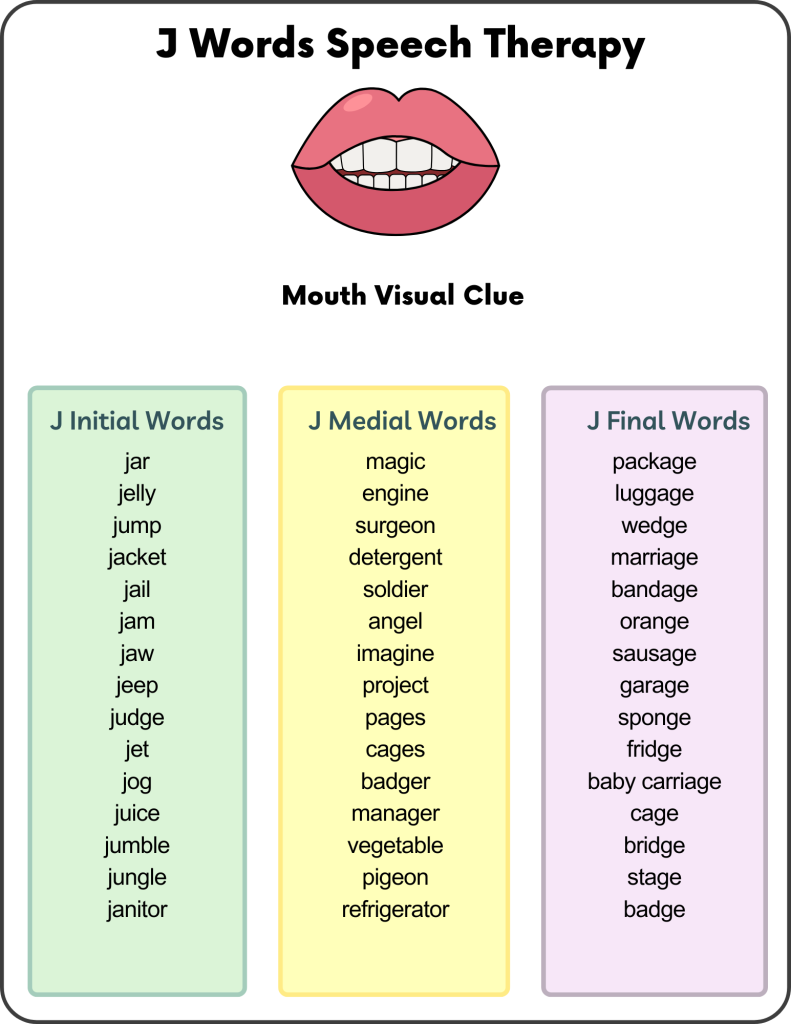
J Words Speech Therapy Printable PDF Worksheet
Understanding J Word Positions
- Initial J Words: These begin with J, like “jam” or “jelly,” where the sound starts with a strong, voiced pop.
- Medial J Words: These have J in the middle, such as “magic” or “engine,” blending J with surrounding sounds.
- Final J Words: These end with J, like “package” or “luggage,” requiring a clear, voiced finish.
D’s voiced nature (vocal cords vibrate) sets it apart from its voiceless twin, T, and practicing it in all positions builds consistency.
Lists of J Words for Practice
Here are kid-friendly J word lists for home use, organized by position and syllable count. Start with the one-syllable words and build up as your child gains confidence.
J Initial Words
One syllable (j): jump, jar, jam, jaw, jay, jazz, jeans, jeep, jet, jig, job, jog, join, joke, joy, judge, jug, juice, junk, just, jail, jade, jab
Two syllables (j): jacket, jackpot, jaguar, jelly, jersey, jewel, jigsaw, jingle, jogging, jolly, journal, journey, joyful, juggle, juicy, jumbo, jumping, jungle, junior, jury
Soft-g J words: gem, gene, gentle, germ, giant, ginger, giraffe, gym, general, generous→(3), gentleman→(3)
J Medial Words
Two syllables: agent, angel, banjo, budget, danger, digit, engine, fidget, gadget, ginger, magic, major, ninja, pigeon, region, subject, tragic, midget
Three or more syllables: allergic, dangerous, imagine, pajamas, refrigerator→(5), vegetable, adjacent
J Final Words
Two syllables: agent, angel, banjo, budget, danger, digit, engine, fidget, gadget, ginger, magic, major, ninja, pigeon, region, subject, tragic, midget
Three or more syllables: allergic, dangerous, imagine, pajamas, refrigerator→(5), vegetable, adjacent
Practice Resources for the J Sound
Free printables and interactive practice for each word position.
Sounds That Are Often Confused With J
This is the most common J substitution — “yump” for “jump,” “yelly” for “jelly.” It happens when the child leaves out the quick “t/d” stop at the start of the sound and just glides in like a “Y.” The fix is to add that little stop: J needs a quick tongue-tip touch behind the top teeth, then a buzzy release. A helpful cue is to start from a “d” and add the buzz — “d… j… jump.” A mirror helps your child see the difference between the open “Y” mouth and the J burst. See our complete Y words list to practice telling the two apart.
Is your child saying “D” instead of J (dump for jump)?
Some children keep the stop but drop the buzzy release, so “jump” becomes “dump” and “jar” becomes “dar.” This is called stopping. J needs both parts — the quick “d” stop AND the “zh” buzz that follows. The cue is to stretch out the buzzy release: “d-zhhh.” Practicing the two side by side helps your child hear the buzz that makes it a J. See our complete D words list.
A note on J and CH: J is the voiced twin of CH — made exactly the same way, but J buzzes while CH is quiet (“gin” vs “chin,” “jeep” vs “cheap”). If your child is working on both, our CH words list pairs naturally with this one.
Tips for Parents to Support Practice
Here’s how to help your child with J words at home:
Make it Fun: Practice sticks best when it’s active, so turn J into a game. Play “Jump for J” — put pictures of J objects (a jar, a jet, a giraffe) on the floor and have your child say “jump!” plus the word each time they leap to a new one. Pairing the sound with a big physical action like jumping makes the connection stronger and keeps a wiggly child engaged. Movement plus sound beats sitting still with flashcards almost every time.
Use in Context: Weaving J words into everyday moments gives lots of natural practice. Slip them into conversation and play — “Let’s jump over the puddle!”, “Do you want juice?”, “Look at the giraffe!” When the sound comes up in real talk, gently model a clear J so your child hears a good example. This low-key repetition helps the sound carry over into everyday speech, which is the ultimate goal.
Repeat with Rhythm: A little repetition builds the muscle memory, and pairing it with movement keeps it playful. Say “jump, jump, jump” while actually jumping, or “jingle, jingle” while shaking a toy. The rhythm and action turn repeats into a game rather than a drill. Aim for lots of quick, cheerful repetitions rather than a few careful ones.
Model the Sound: Children learn by copying, so model J clearly, exaggerating that quick buzzy burst — “J-j-jump” — and letting your child watch your mouth. Point out that the tongue taps up behind the teeth and then buzzes out, and have them touch their throat to feel the voice. A mirror helps them match your mouth. Celebrate every good try; encouragement keeps a child motivated to keep practicing a tricky later sound.
Use Visual Aids: Pictures and objects give a young child something concrete to connect the sound to. Use flashcards, or point out real J things — jam at breakfast, a jacket by the door, a jar on the shelf. Seeing or touching the object as they say the word makes practice meaningful and memorable. Rotating through favorite, motivating pictures keeps them engaged far longer than repeating the same word.
If your child continues to struggle with the J sound after practice, consider seeking help from a speech therapist for personalized guidance.. The J sound is a doorway to clear speech, and you’re ready to help your child master it! With these J initial, medial, and final word lists and easy home tips, practice can be a delight. Keep it steady and playful, and don’t hesitate to seek a professional speech therapist if needed.
J Words FAQs
Why does my child say “Y” instead of “J” (yump for jump)?
Saying “yump” for “jump” happens when the quick stop at the start of the J sound is left out, so it glides in like a “Y.” The fix is to add a quick tongue-tip tap behind the teeth and a buzzy release — starting from a “d” and adding the buzz (“d… j”) helps.
At what age should my child say the J sound?
J is one of the later sounds, usually mastered by around age 5 to 6. Earlier substitutions like “yump” for “jump” are common and often nothing to worry about at younger ages.
Why is the J sound spelled so many ways?
The J sound can be spelled with “j” (jump), a soft “g” (giraffe, gem), or “dge” (bridge, judge). They all make the same sound, so all of them are good J practice — which can be confusing for early readers.
What sounds are related to J?
J is the voiced twin of CH (same mouth movement, but J buzzes). Children most often replace it with Y (“yump” for “jump”) or D (“dump” for “jump”). Practicing J alongside these helps children hear and feel the differences.