F Words in Speech Therapy
November 19, 2025
Sh Words in Speech Therapy
November 19, 2025Introduction to Ch Words in Speech Therapy
Hello, parents! If your child is working on the CH sound—written as “ch” and pronounced like “church”—this guide is for you. The CH sound, a voiceless affricate, starts with a “t” stop (tongue tip on the alveolar ridge) and releases into a “sh” fricative, all in one quick burst. It’s typically mastered by age 4–6, but some kids may replace it with “T” (e.g., “tair” for “chair”) or “SH” (e.g., “share” for “chair”). This article provides lists of CH initial, medial, and final words, plus practical tips to make practice engaging and effective at home, helping your child’s speech.
The easiest way to think about CH is as two quick sounds joined together: a “t” immediately followed by “sh.” Your child stops the air with the tongue tip behind the top teeth, then releases it in a little burst — “t-sh” said fast becomes “ch.” Two everyday tricks make this click: a pretend sneeze (“a-a-a-CHOO!”) ends in a natural CH, and a toy train (“choo-choo!”) gives lots of playful repetitions. Both help your child feel that quick stop-and-burst that defines the sound.
On this page you’ll find a complete, organized list of CH words — grouped by position and syllable count so you can start simple and build up — along with free printable worksheets, games, and a plain-language explanation of the sounds most often confused with CH. New to teaching this sound? Start with our full guide on how to teach the CH sound, then come back here for the word lists and practice resources.
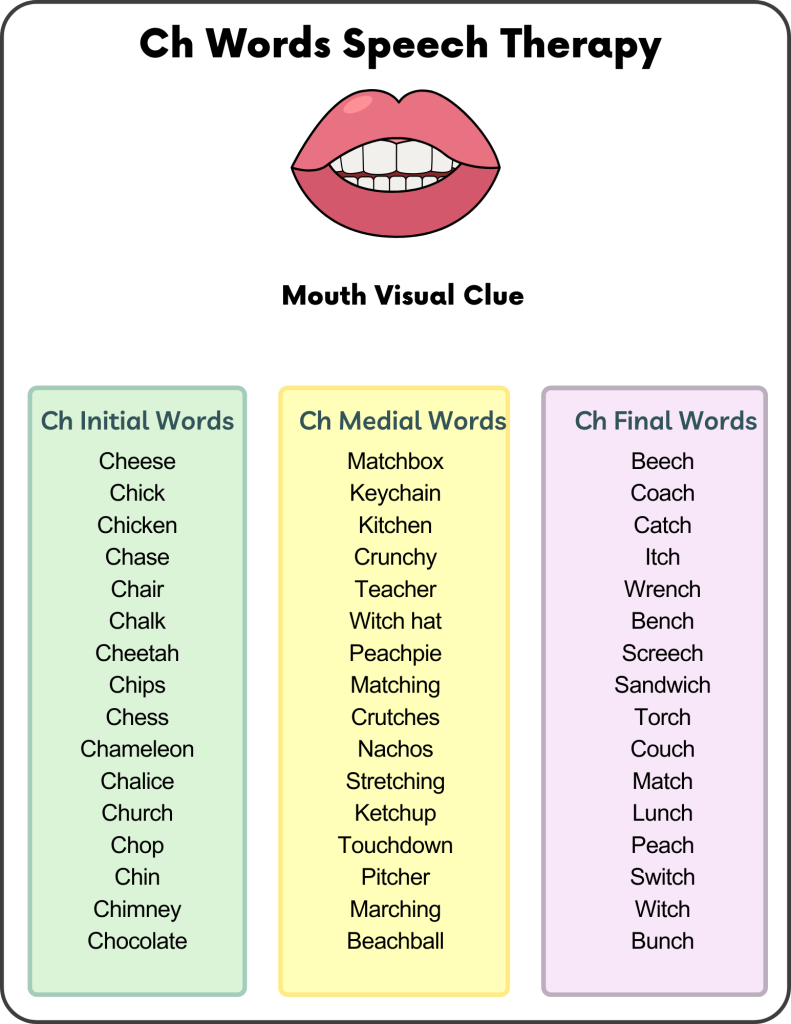
Ch Words Speech Therapy Printable PDF Worksheet
Understanding Ch Word Positions
- Initial CH Words: Start with CH, e.g., “chair,” “cheese.” The affricate burst is prominent.
- Medial CH Words: Have CH mid-word, e.g., “teacher,” “kitchen.” These test CH’s flow within sequences.
- Final CH Words: End with CH, e.g., “watch,” “beach.” These require a voiceless closure, sometimes simplified.
Lists of Ch Words for Practice
Here are kid-friendly CH word lists for home use, organized by position and syllable count. Start with the one-syllable words and build up as your child gains confidence.
Ch Initial Words
One syllable: chair, cheese, chip, chop, chin, chick, chalk, chase, chest, chew, chill, choose, church, chunk, chomp, chore, chime, cheek, cheer, cheat, cheap, champ, chum, chart, charm, chat, chief, choke
Two syllables: chicken, cherry, cheetah, checkers, chili, chipmunk, chapter, chimney, chocolate→(3), chubby, chuckle, chowder, cheddar, cheerful, chestnut, chicken, chatter, chapstick, charcoal
Three or more syllables: chocolate, chimpanzee, cheerleader, cheeseburger, championship, chinchilla, chandelier
Ch Medial Words
Two syllables: teacher, kitchen, matches, pitcher, catcher, ketchup, nachos, orchard, bleachers, marching, munching, watches, sketching, ranch hand
Three or more syllables: sandwiches, adventure, furniture→(soft—remove), armchair, cupcake→(no—remove), franchise
Ch Final Words
One syllable: beach, watch, catch, match, much, such, rich, which, teach, reach, peach, each, coach, couch, ditch, itch, latch, lunch, march, patch, pinch, punch, ranch, sketch, switch, touch, bunch, branch, crunch, hatch, pitch, porch, witch
Two syllables: attach, ostrich, sandwich, spinach
Practice Resources for the CH Sound
Free printables and interactive practice for each word position.
Sounds That Are Often Confused With CH
Is your child saying “SH” instead of CH (share for chair)?
SH and CH sound similar and are made in almost the same place, but there’s a key difference. SH is one long, continuous stream of air (“shhh”), while CH is a quick stop-and-burst — a tiny “t” followed by “sh.” When a child leaves out that quick “t” stop at the start, “chair” comes out as “share” and “chips” as “ships.” The cue is “stop the air first, then let it burst.” A pretend sneeze (“a-a-a-CHOO!”) helps your child feel the explosive release that makes it CH rather than SH. See our complete SH words list to practice telling the two apart.
Is your child saying “T” instead of CH (tair for chair)?
This happens when a child produces the “t” stop at the start of CH but doesn’t release it into the “sh” part — so “chair” becomes “tair” and “chip” becomes “tip.” CH needs both pieces: the quick stop AND the airy burst that follows. The “choo-choo train” trick helps here — the drawn-out “chooo” naturally adds the “sh” release the T is missing. Practicing the two side by side helps your child hear the burst. See our complete T words list.
A note on CH and J: CH has a voiced twin — the J sound. They’re made exactly the same way; CH is quiet (just air) and J buzzes (“chin” vs “gin”). If your child is working on both, our J words list pairs naturally with this one.
Tips for Parents to Support Practice
Here’s how to help your child with Ch words at home:
Pop and Hiss: CH is really two sounds joined together — a quick “t” stop followed by a “sh” burst — so help your child feel both parts. Say “chair” with an exaggerated “tch” burst, drawing attention to how the sound stops and then explodes out. Have them put a hand near their mouth to feel the little puff of air on the release. Once they can feel that stop-and-burst, they’ve found the heart of the CH sound.
Sneeze It Out: A pretend sneeze is one of the best CH tricks, because “a-a-a-CHOO!” ends in a natural CH. Sneeze together dramatically a few times, exaggerating the “CHOO” part, then see if your child can make just the “CH” on its own. Kids find this genuinely funny, which keeps them practicing without it feeling like work. The sneeze gives them a whole-body way to feel the explosive burst.
Ride the Train: If you have a toy train, you have a CH goldmine. As the train rolls, say “choo-choo!” or “chug-chug-chug!” — each one a perfect CH repetition wrapped in play. You can “check” tickets, let passengers “choose” a seat, or pull into a station. The drawn-out “chooo” also naturally adds the “sh” part, which helps if your child tends to say “T” instead. Playing this way gives lots of happy repetitions without a single drill.
Blend into Everyday Talk: Practice sticks best when it shows up naturally, so weave CH words into your day — “Sit in the chair,” “Do you want cheese?”, “Let’s watch the show.” When the sound comes up in real moments, gently model a clear CH so your child hears a good example. Mealtimes are especially handy, with “cheese,” “chicken,” “chips,” and “chocolate” all on the menu. This everyday repetition is what helps the sound carry over into real speech.
Celebrate the Burst: Learning CH takes many tries, and encouragement keeps a child willing to keep going. Praise the effort, not just the perfect production — “I heard that big CH burst!” — so your child feels successful along the way. If a word is hard, drop back to an easy favorite they can do well, then build up again. Keeping practice warm, playful, and pressure-free matters just as much as getting the sound exactly right.
If your child swaps CH for T (“tair” for “chair”) or SH (“share” for “chair”), a speech-language pathologist can help with tongue positioning and the stop-and-burst timing.
Conclusion
The CH sound is a cheerful challenge for clear speech, and you’re set to help your child master it! With these CH initial, medial, and final word lists and easy home tips, practice can be a joy. Keep it fun and steady, and don’t hesitate to seek a professional if needed—your support is a champion for their words!
CH Words FAQs
How is the CH sound made?
CH is two sounds joined together — a quick “t” stop followed instantly by “sh.” The tongue stops the air behind the top teeth, then releases it in a burst, with the lips pushed slightly forward. Saying “t-sh” quickly makes a “ch.”
Why does my child say “SH” or “T” instead of “CH”?
Saying “share” for “chair” means the quick “t” stop is missing; saying “tair” means the “sh” burst is missing. CH needs both. A pretend sneeze (“achoo”) or a “choo-choo” train helps your child feel the full stop-and-burst.
What are the easiest CH words to start with?
Start with fun, motivating words like “chair,” “cheese,” “chip,” and “beach,” where the CH is easy to hear at the beginning or end.
What sounds are related to CH?
CH is closely related to SH (“share” vs “chair”) and T (“tair” vs “chair”), the two sounds children most often substitute. It’s also the voiceless partner of J — same mouth movement, but J buzzes. Practicing these together helps children hear the differences.