Ch Words in Speech Therapy
November 19, 2025
Th Words in Speech Therapy
November 19, 2025Introduction to Sh Words in Speech Therapy
Hello, parents! If your child is working on the SH sound, this guide is here to help. The SH sound—a voiceless palato-alveolar fricative made by rounding the lips, pulling the tongue back, and letting a steady stream of air flow out—is one children often find tricky, and some replace it with an easier sound like “S” (saying “sip” for “ship”). This article offers lists of SH initial, medial, and final words, plus practical tips to make practice enjoyable and effective at home.
The SH sound has a nice, memorable cue built right in: it’s the “quiet” sound we make when we ask someone to be still — “shhh.” That gives children an everyday hook to hold onto, and because the lips round forward in a way they can see in a mirror, SH is often a little easier to shape than sounds made hidden at the back of the mouth. Most children master it with clear modeling and some playful, regular practice.
On this page you’ll find a complete, organized list of SH words — grouped by position and by syllable count, so you can start simple and build up — along with free printable worksheets, games, and a plain-language explanation of the sounds most often confused with SH. New to teaching this sound? Start with our full guide on how to teach the SH sound, which walks through exactly how to help your child produce it. Then come back here for the word lists and practice resources.
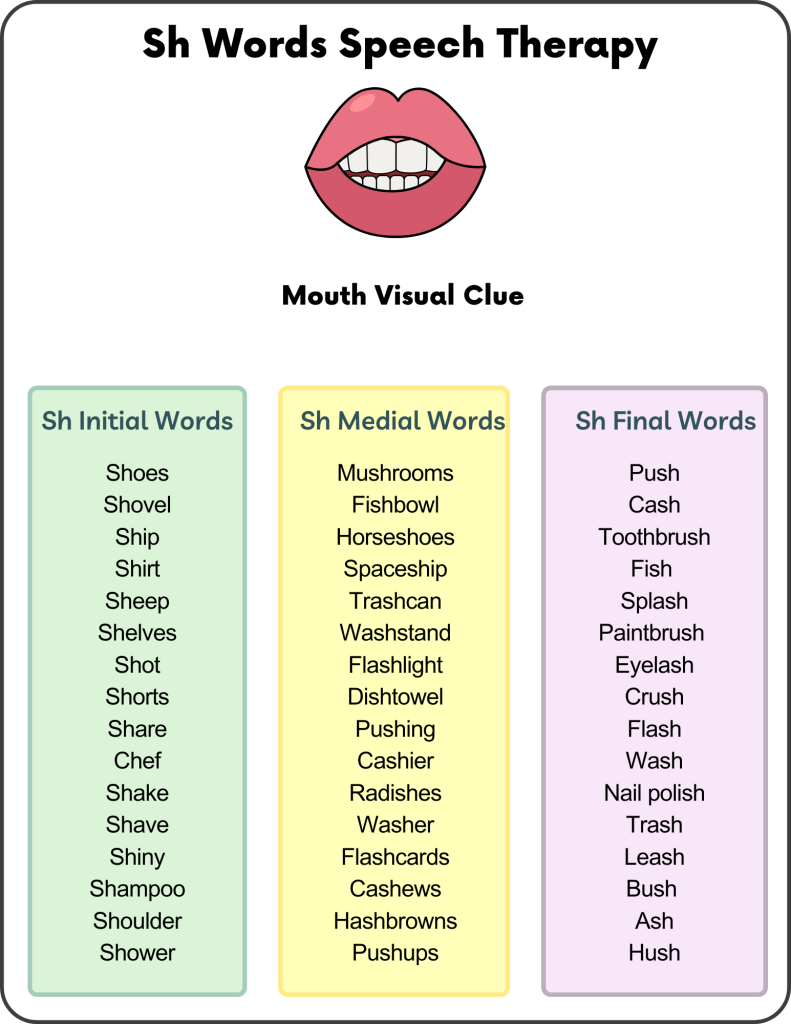
Sh Words Speech Therapy Printable PDF Worksheet
Understanding Sh Word Positions
- Initial SH Words: Begin with SH, such as “ship” or “shoe,” starting the word with a long, quiet “shhh.”
- Medial SH Words: Have SH in the middle, like ‘cashews’ or ‘washer’, requiring smooth blending.
- Final SH Words: End with SH, as in ‘bush’ or ‘fish’, needing a soft, voiceless finish
Lists of Sh Words for Practice
Here are kid-friendly SH word lists for home use, organized by position and syllable count. Start with the one-syllable words and build up to the longer ones as your child gains confidence.
Sh Initial Words
One syllable: ship, shoe, shark, sheep, shell, shirt, shop, shut, shed, she, shy, sheet, shine, shave, shade, shake, shape, share, sharp, shall, shame, shawl, shock, shoot, shore, short, shot, shout, show, shower, shrug, shush
Two syllables: shampoo, shadow, shaker, shampoo, shapes, sharpen, shatter, shaving, shelter, sheriff, shimmer, shiny, shipment, shipping, shipwreck, shiver, shocking, shoelace, shoreline, shortcake, shoulder, shovel, shower, shutter, shuttle
Three or more syllables: shampooing, shatterproof, shepherd
Sh Medial Words
Two syllables: cashews, washer, dishes, ashes, brushing, cushion, fashion, fishing, flashlight, machine, mushroom, ocean, pushup, tissue, washing, wishing, bishop, crashing
Three or more syllables: dishwasher, milkshake, national, seashell, sunshine, insurance
Sh Final Words
One syllable: bush, fish, dish, wish, wash, brush, cash, dash, fresh, gush, hush, leash, mash, mesh, mush, push, rash, rush, sash, splash, squash, swish, trash, ash, crash, flash
Two syllables: eyelash, finish, goldfish, jellyfish, polish, punish, radish, rubbish, selfish, starfish
Free printables and interactive practice for each word position.
Sounds That Are Often Confused With SH
Is your child saying “S” instead of SH (sip for ship)?
This is the most common SH difficulty. The S and SH sounds are close cousins — both are long, flowing sounds made with air — but the tongue and lips sit differently. For S, the tongue is forward and the lips are relaxed; for SH, the tongue pulls back and the lips round forward, like getting ready for a kiss. When a child keeps the tongue too far forward, “ship” comes out as “sip” and “shoe” as “Sue.” A helpful cue is to have your child make an “sss,” then pull the tongue back and round the lips into “fish lips” to slide into “shhh.” A mirror makes the lip rounding easy to see. See our complete S words list to practice the contrast.
Is your child mixing up SH and CH (share for chair)?
SH and CH sound similar, and they’re made in almost the same place — but there’s a key difference. SH is one long, continuous stream of air (“shhh”), while CH is a quick stop-and-burst, like a tiny “t” followed by “sh.” Because they’re so close, children sometimes swap them, saying “share” for “chair” or “ships” for “chips.” The trick is helping your child feel that SH flows and stretches out, while CH pops and stops. Practicing the two side by side helps them hear the difference. See our complete CH words list.
Tips for Parents to Support Practice
Here’s how to help your child with Sh words at home:
Feel the Quiet Air: The SH sound is the same one we use to ask for quiet — “shhh” — so your child already knows it, even if they don’t realize it yet. Have them whisper a long “shhh” as if soothing a baby doll or a sleeping pet, and point out how the lips round forward and the air keeps flowing. Because it’s a continuous sound, they can stretch it out as long as one breath lasts, which makes it easy to feel. Doing this in front of a mirror lets them watch their lips make the rounded “fish” shape.
Round the Lips: The rounded lip position is what separates SH from S, so it’s worth drawing attention to. Ask your child to make “fish lips” or a gentle kiss shape before they start the sound — this naturally sets the mouth up for a clear SH. You can even have them look in the mirror and check their own lips are round before each try. Once the lips are in the right spot, the SH often falls into place on its own.
Add Visuals: Pictures give a young child something concrete to aim for and keep practice moving quickly. Use flashcards or point out real objects — a ship, a shark, a brush, a fish — and have your child name each one, emphasizing the “shhh.” Keep the pace light and quick, like a game of I-spy, so it feels playful rather than like a lesson. Rotating through familiar, motivating pictures also keeps them engaged far longer than repeating the same word.
Blend into Everyday Talk: Practice that happens naturally throughout the day adds up fast. Slip SH words into ordinary moments — “Let’s wash your hands,” “Where are your shoes?”, “Look at the fish!” — so the sound comes up again and again without pressure. When it appears in real conversation, gently stretch the “shhh” so your child hears a good model. This kind of low-key repetition helps the sound carry over into their everyday speech, which is the real goal.
Celebrate the Tries: Learning a new sound takes lots of attempts, and encouragement is what keeps a child willing to keep trying. Praise the effort, not just the perfect production — “I love how you rounded your lips!” — so your child feels successful along the way. If a word is hard, drop back to an easier one they can do well, then build back up. Keeping practice warm and positive matters just as much as getting the sound exactly right.
If your child swaps SH for S (e.g., “sip” for “ship”) or leaves it off the end of a word (e.g., “fi” for “fish”), a speech therapist can offer targeted strategies. Steady, playful practice at home makes a real difference between sessions.
Conclusion
The SH sound brings richness and clarity to speech, and you’re equipped to help your child shine! With these SH word lists and playful practice ideas, progress will feel natural and fun. Keep cheering them on, and reach out to a speech therapist if needed — your support sets them up for success
SH Words FAQs
What are the easiest SH words to start with?
Short, one-syllable words where the SH is easy to hear are best — “shoe,” “ship,” “fish,” and “wash.” Many children find initial SH (start of the word) easier than final SH, so beginning words are a good place to start.
How many SH words should we practice at once?
A small handful — about 5 to 10 words per short session — repeated a few times a day works better than one long drill. Short and playful beats long and tiring.
Why does my child say “S” instead of “SH”?
S and SH are made in a similar way, but SH needs the tongue pulled back and the lips rounded. If the tongue stays too far forward, “ship” comes out as “sip.” The cue “make fish lips” helps round the lips for a clear SH.
What sounds are related to SH?
S is the sound most often substituted for SH (“sip” for “ship”), and CH is closely related — SH flows while CH pops and stops. Practicing SH alongside these helps children hear and feel the differences.