Sh Words in Speech Therapy
November 19, 2025P Words Speech Therapy Phrases Worksheet
December 8, 2025Introduction to Th Words in Speech Therapy
Hello, parents! If your child is working on the TH sound, this guide has your back. TH can be voiceless (as in thumb) or voiced (as in this). Both are made by gently placing the tongue between the teeth and blowing air. TH is usually mastered between ages 5–7 and is one of the trickiest sounds. Kids often replace it with F (“fumb” for thumb) or D (“dat” for that). This article includes TH initial, medial, and final word lists for both types of TH, plus easy ways to practice at home.
One thing that makes TH unique is that it’s the only English sound where the tongue actually comes out between the teeth — you can see the tip peeking through. That’s actually good news for practice: unlike sounds hidden inside the mouth, TH is highly visible, so a mirror becomes one of your best tools. When your child can watch their own tongue tip come forward, the “invisible” part of the sound suddenly becomes something they can copy.
Because TH develops later than most sounds — often not until age six or seven — it’s completely normal for younger children to substitute an easier sound for a while. On this page you’ll find a complete, organized list of both voiced and voiceless TH words, grouped by position, along with free printable worksheets, games, and a plain-language explanation of the sounds most often confused with TH. New to teaching this sound? Start with our full guide on how to teach the TH sound, then come back here for the word lists and practice resources.
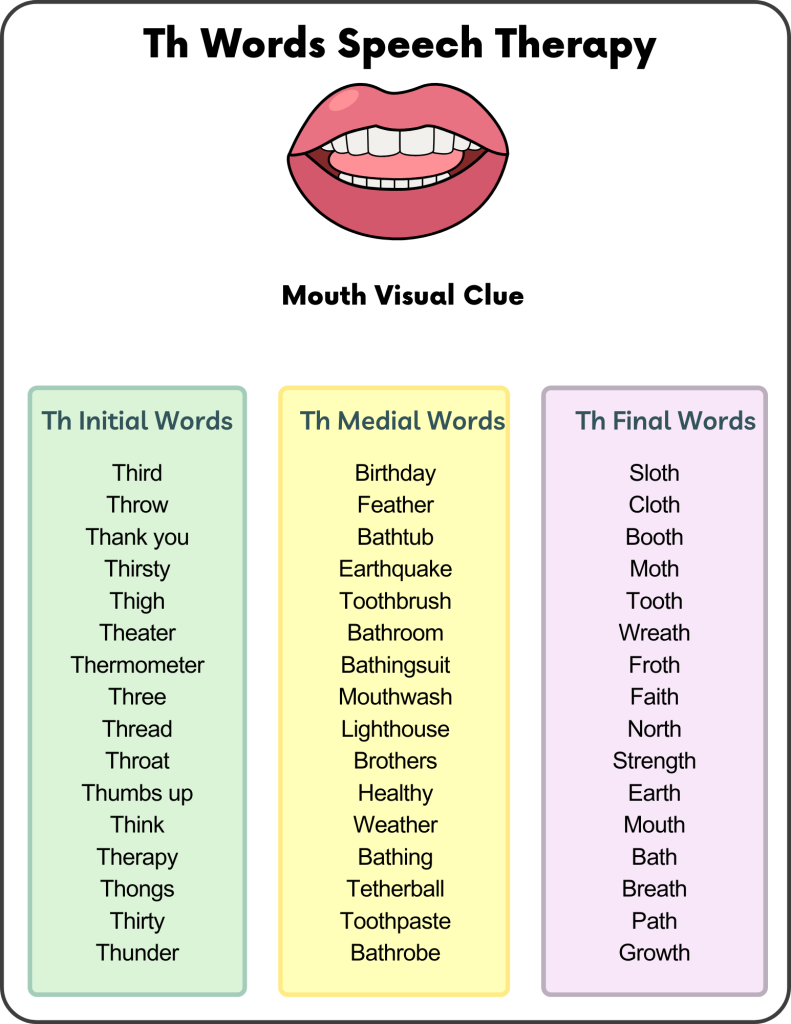
Th Words Speech Therapy Printable PDF Worksheet
Understanding Th Word Positions
- Initial TH Words: Begin with TH, like thumb or that, where the tongue pops lightly between the teeth.
- Medial TH Words: Have TH in the middle, like bathing or weather.
- Final TH Words: End with TH, like bath or teeth, requiring a soft, airy finish.
Lists of Th Words for Practice
Here are kid-friendly TH word lists for home use, split into voiceless and voiced and organized by position. Start with simple, familiar words and build from there.
Th Initial Words
Voiceless (think): thank, thaw, theme, thick, thief, thigh, thin, thing, think, third, thirsty, thirteen, thirty, thorn, thought, thousand, thumb, thunder, Thursday Voiced (this): than, that, the, their, them, then, there, these, they, this, those, though, thus
Th Medial Words
Voiceless: anything, athlete, bathtub, birthday, everything, healthy, marathon, method, nothing, python, something, toothbrush, toothpaste Voiced: brother, clothing, either, father, feather, gather, leather, mother, other, rather, together, weather, whether
Th Final Words
Voiceless: bath, both, cloth, earth, fourth, math, mouth, north, path, teeth, tenth, tooth, with, worth, breath Voiced (spelled “the”): bathe, breathe, smooth, soothe
Practice Resources for the TH Sound
Free printables and interactive practice for each word position.
Sounds That Are Often Confused With TH
Is your child saying “F” instead of TH (fumb for thumb)?
This is one of the most common TH substitutions, and it’s easy to see why: F and TH both use gentle airflow and can look similar from a distance. The difference is where the sound is made. F is made with the top teeth on the bottom lip, while TH is made with the tongue tip poking out between the teeth. When a child hasn’t learned to bring the tongue forward, “thumb” becomes “fumb” and “bath” becomes “baf.” The fix is very visual — have your child watch in a mirror and practice sticking the tongue tip out just a little between the teeth to blow the air. See our complete F words list to practice telling the two apart.
Is your child saying “D” instead of TH (dat for that)?
This usually happens with the voiced TH (the buzzy one in “this” and “that”). D and voiced TH are both voiced, but D is made with the tongue tip up behind the teeth, while TH needs the tongue between the teeth. When the tongue stays inside, “that” becomes “dat” and “them” becomes “dem.” The cue is the same as above: get the tongue tip to peek out between the teeth. A mirror, and even gently reminding your child to “stick your tongue out a tiny bit,” makes a big difference. See our complete D words list.
Tips for Parents to Support Practice
Here’s how to help your child with Th words at home:
Show the Tongue: TH is the one sound where the tongue actually comes out between the teeth, so make the most of that visibility. Exaggerate the movement when you model it — “Look, my tongue sticks out to say thhh!” — and invite your child to copy you. Because they can see exactly what to do, this sound is often easier to shape than hidden sounds like K or G. Gently sticking the tongue tip out a little is the whole secret, so celebrate when they get it peeking through.
Use a Mirror: A mirror is one of the best tools for TH, because seeing the tongue in the right spot gives instant feedback. Have your child watch their own mouth as they practice, checking that the tongue tip comes forward between the teeth. Kids often enjoy watching themselves, which turns practice into something a bit like a game. If the tongue stays hidden inside, the mirror makes it obvious so they can adjust.
Feel the Air (and the Buzz): TH comes in two flavors, and feeling the difference helps. For the voiceless TH (“think,” “bath”), have your child hold a hand in front of the mouth to feel the little puff of air. For the voiced TH (“this,” “mother”), have them touch their throat to feel the buzz. Playing with “which one buzzes?” helps your child notice that both sounds are made the same way, just with or without the voice — and that awareness makes the sound easier to control.
Practice the Everyday Words: The voiced TH shows up in tiny words we use constantly — “the,” “this,” “that,” “them,” “there.” Because these appear in almost every sentence, getting them clear can improve your child’s overall speech more than almost anything else. Weave them into normal talk — “Look at that!”, “Give me the ball,” “Where are they?” — and gently model the TH. Practicing these high-frequency words pays off quickly in everyday conversation.
Keep It Light and Patient: TH is a later sound, so patience matters more here than with early sounds. If your child is younger than five or six, some substitution is completely normal and nothing to worry about. Keep practice short, playful, and free of pressure, and celebrate close attempts rather than demanding perfection. Warmth and consistency will carry your child further than long, serious drills.
If your child continues to substitute F or D for TH past age seven, or it’s affecting how well others understand them, a speech-language pathologist can offer targeted help.
Conclusion
TH brings clarity and detail to speech, and with these word lists and simple activities, you can help your child master both versions. Keep practice light and playful, and don’t hesitate to reach out to a therapist if needed — your guidance makes all the difference!
TH Words FAQs
What’s the difference between voiced and voiceless TH?
Both are made with the tongue between the teeth. Voiceless TH (“think,” “bath”) is just air, while voiced TH (“this,” “mother”) adds a throat buzz. You can feel the difference by touching your throat — the voiced TH makes it vibrate.
What are the easiest TH words to start with?
Start with simple, visible words like “thumb,” “think,” “bath,” and “tooth,” where the tongue-between-teeth position is easy to see and feel in a mirror.
At what age should my child say TH correctly?
TH is one of the latest sounds to develop — many children aren’t fully correct until age six or seven. Earlier substitutions like “fumb” for “thumb” are common and usually nothing to worry about at younger ages.
What sounds are related to TH?
Children most often substitute F (“fumb” for “thumb”) or D (“dat” for “that”) for TH. Practicing TH alongside these sounds — with a mirror to show the tongue between the teeth — helps children hear and see the difference.